
Beyond Borders: Migration's Influence on German Politics and Society
A Macro View, From Open Borders to Deterrence
The world has witnessed the relationship between migration and the transformation of the societies migrants enter continuously throughout human history. That being said, Europe's recent iteration has altered the continent's political landscape.
According to Eurostat (2025), Germany received the largest number of first-time asylum applications in the EU in 2024, with approximately 230,000 applications. This large demographic change has not gone unnoticed by society. Germany’s migrant population in recent times has slowly eroded the nation’s post-World War II silent consensus among political parties to avoid weaponizing migration issues in electoral campaigns. A process once managed through practical governance has developed into a polarizing “wedge issue”, a politically divisive issue, with strong mobilizing potential to reshape voter alignments and destroy party loyalties (Schmidtke, 2025).
Today, migration in Germany acts as a political cleavage that overwhelms standard socio-economic debates, deep-seated public anxieties over cultural belonging, national security, and welfare distribution. This evolution has become so pronounced that during the 2025 federal election, even traditional centrist parties were compelled to adopt hard-line, restrictive rhetoric to compete with a rising right-wing populist opposition (Schmidtke, 2025).
The Ballot Box to Classroom Frictions
The most obvious effect of Germany’s increasingly eroding political atmosphere has been the ballot box. The surging anti-immigration party, the Alternative for Germany (AfD), gained significant support in 2023 amid growing public dissatisfaction with the federal coalition government and has successfully weaponized nationalist rhetoric to challenge established democratic parties. By painting migration as an external threat that needs to be dealt with rapidly while capitalizing on identity-driven nationalism, the far-right party has successfully grown its legislative foundation. However, analyzing this phenomenon solely through election statistics ignores the lived human reality on the ground.
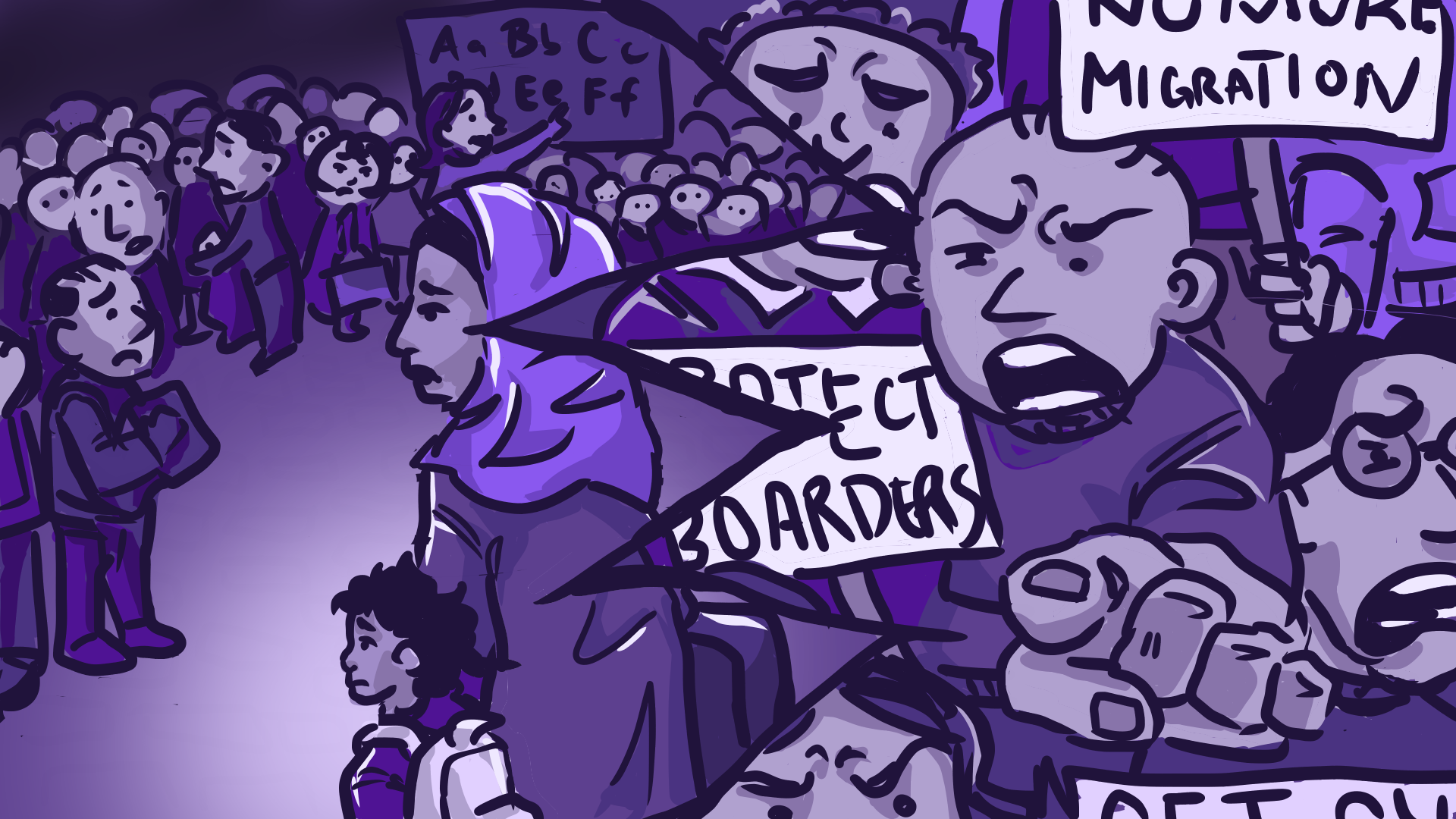
For migrants hoping to integrate into German society, this political environment translates into social alienation and heightened cultural friction, which manifests both largely and visibly in spaces such as public schools. This micro-level reality is particularly evident in public schools, where educational staff and Muslim migrant families frequently encounter tension over religious integration, turning classrooms into microcosms of political tension. German teachers have reported tensions surrounding mandatory swimming lessons, Muslim women’s choices to wear headscarves, and broader uncertainty over the extent to which schools should accommodate religious practices while maintaining institutional neutrality (Veszprémy, 2025). At the heart of this evolving public opinion lies a pervasive fear over national identity and social cohesion. As globalization accelerates, native populations increasingly express collective anxiety over losing their cultural heritage and overall displacement. Contextualizing this rapid shift in public sentiment includes observing recent survey data that illustrates how deeply voter priorities have transformed over the last ten years. In early 2025, German polls proved that 68 percent of Germans believed the country should admit fewer refugees, compared to 50 percent in 2020 (Schmidtke, 2025). This hardening of public opinion illustrates the underlying reason immigration has overtaken traditional economic or healthcare-related concerns to become the primary driver of modern European electoral outcomes.
The Policy Pivot
Faced with an increasingly anxious electorate and the momentum of the far-right movement, Germany's governing institutions have implemented numerous changes to the nation's immigration and asylum policies. Policies designed around integration have been replaced by deterrence measures, including the placement of permanent border checks and aggressive deportation schemes.
Historically, the center-right Christian Democratic Union (CDU) largely abandoned its former centrist policies to advocate for stringent border controls, accelerated deportations, and strict residency limitations (Mahesh 2026). The peak of this policy change was seen in 2025 with the introduction of the controversial Zustrombegrenzungsgesetz (Influx Limitation Law), a law aimed at significantly tightening asylum and immigration rules, including denying asylum seekers at the border and tightening family reunification policies. Aware that the proposed bill lacked support from centrist coalition partners, the CDU slyly accepted votes from the AfD to secure its passage. The act of relying on far-right support shattered Germany’s historic Brandmauer (firewall), an informal political strategy where parties refuse to form governing coalitions or cooperate with extremist parties (Schmidtke, 2025). This legislative act demonstrated to German society that security-driven policy maneuvers do not exist in a vacuum, as the breach created nationwide protests, revealing how migration pressures have destabilized Germany's established democratic norms.
Interestingly, while Germany’s far-right political surge has reshaped immigration policy and views, the surge has not created widespread support for the AfD’s broader economic positions on privatization or tax reform. Instead, migration acts as an overpowering wedge issue that overrides traditional socio-economic debates entirely (Schmidtke, 2025).
The Path Ahead
The outcomes of Germany’s political shifts carry profound and arguably paradoxical implications for Europe at large. The ripple effects of the nation’s shift threaten to undermine its fiscal and structural stability in countless ways. Macroeconomic data spanning decades illustrate that European economies have been and continue to be dependent on labour from non-European natives to offset the region’s aging populations and maintain the solvency of national welfare systems (Schmidtke, 2025). By restricting immigration to appease populist sentiment, economists believe European member states risk triggering severe economic stagnation. Additionally, empirical political data proves that when moderate parties adopt exclusionary policies, they do not shrink far-right support but instead legitimize the anti-immigrant narrative and drive voters toward the populist original (Schmidtke, 2025).
Looking towards the future, Germany stands at a vital crossroads. What the future holds depends heavily on its ability to navigate society’s current concerns and to transcend this self-defeating cycle. Germany must move beyond polarizing binaries, as timeless stability requires a balanced approach to be used when creating policies, both acknowledging the economic necessity of migration while considering the human dignity of those seeking refuge. European leadership must bridge the existing gap and develop cohesive immigration policies that secure national borders while integrating migrants as essential contributors to a shared, multicultural future.