
The Beautiful Game, the Ugly Politics
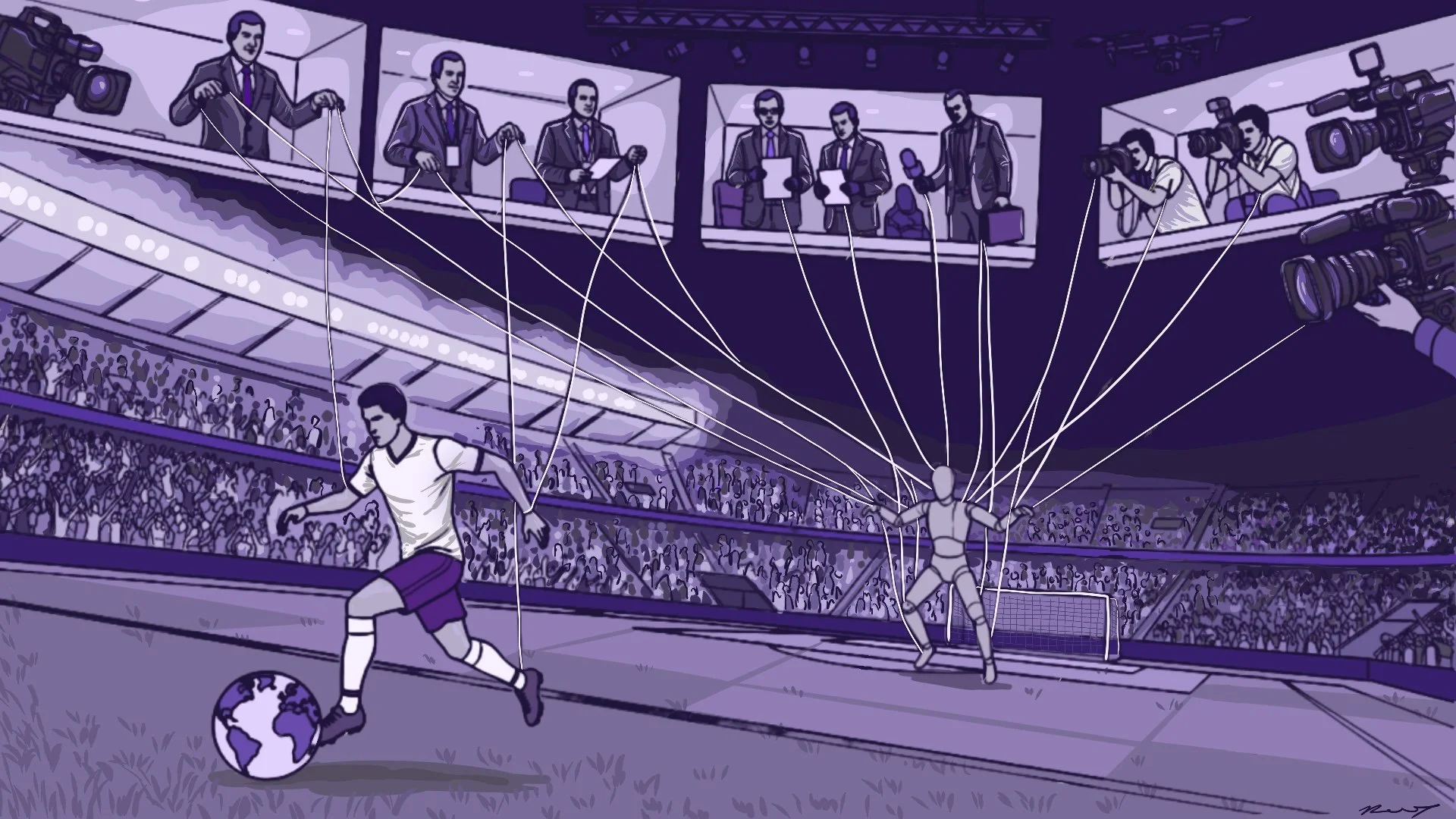
Illustrated by Renee Xia
July 19, 2026, Spain beat Argentina 1-0 at MetLife Stadium in New Jersey to win the 23rd men’s World Cup, and Donald Trump (who spent the tournament inserting himself into everything from the trophy ceremony to a player’s disciplinary hearing) took to social media to congratulate the FIFA president Gianni Infantino and thanked “all others involved”. Matthew Neschis at Yahoo Sports noted, he did not congratulate Spain.
This small, telling omission captures something that the 2026 World Cup has made evident: the tournament was never just about soccer. This year, the World Cup was hosted across three countries, watched by billions, and shadowed by immigration raids, human rights reports, racist outbursts, ticket-price scandals, and an American president who phoned FIFA to overturn a red card. This year, the politics stopped hiding in the stands and walked straight onto the pitch.
From Humble Beginnings to Global Obsession
FIFA, soccer’s international governing body, was established in 1904 but its defining moment came in 1928, when its congress voted to launch a standalone global tournament: the World Cup.
Jules Rimet, FIFA’s president at the time, drove the initiative forward. Uruguay was chosen to host, riding off the high of their constitution’s 100th anniversary and back-to-back Olympic soccer title; it didn’t hurt they offered to pay travel expenses for all competing nations as well. Even in its very first edition, the World Cup was never just a sporting event with the first host nation already using the tournament to celebrate its own political identity, a dynamic that would only deepen in the decades to follow.
Ultimately, thirteen teams traveled to represent their countries in Montevideo, Uruguay, in July of 1930. History describes how the first ever World Cup culminated in Uruguay’s 4-2 victory over Argentina in the inaugural final, with a crowd of 93,000 cheering them on!
How the Sausage Gets Made…
Where Uruguay’s bid relied on footballing infrastructure and generous financial promises, the present reality of hosting the World Cup is not simply awarded to whichever country submits the nicest stadium renderings; instead, it is decided by a bidding process run by FIFA’s member associations through internal votes by FIFA’s executive committee. More recently, its involved evaluations and congress votes involving all 211 member federations.
For decades, that process has been a magnet for allegations of corruption, including vote-buying, bribery, and backroom deals. Most infamously, the 2010 vote that awarded Russia the 2018 World Cup and Qatar the 2022 tournament, a decision still tied to corruption indictments against prior year’s FIFA officials.
When Canada, the United States, and Mexico put together a joint bid in the mid-2010s, then-candidate and later President Trump publicly lobbied foreign governments to support it. Even telling Nigeria’s president at a White House press conference in 2018 that he expected African nations to back the North American bid in exchange for American goodwill. This request sat uneasily against FIFA’s own code of ethics which formally prohibits government interference in the bidding process, PBS News observed. However, FIFA’s response was characteristically toothless: a statement noting only that such rules exist.
That same dynamic resurfaced, albeit more brazenly, once the tournament arrived in North America. In July 2026, following American forward Folarin Balogun’s suspension due to a red card, Trump called Infantino directly to ask FIFA to reverse the ban and return Balogun to play. The New York Times discusses that (unsurprisingly) FIFA overturned the decision, leading Trump to exclaim “Thank you to FIFA for doing what was right, and reversing a great injustice!” on Truth Social. Sports columnists and human rights advocates alike describe the decision as a “slippery slope”, especially mid-tournament.
Win the Bid, Win the Narrative
Human Rights Watch describes how hosting the World Cup has become one of the most effective tools in the authoritarian playbook for “sportswashing”: using the spectacle, prestige, and positive media coverage of a global sporting event to launder a country’s international reputation and distract from its human rights record.
Sportswashing isn’t the only thing autocracies do to themselves, as it can also work in reverse revealing a democracy’s own contradictions. While the United States hosted the bulk of the 2026 tournament, its own immigration enforcement apparatus became a defining storyline of the event.
The Department of Homeland Security confirmed months before kickoff that Immigration and Customs Enforcement (ICE) agents would be present in and around World Cup stadiums as part of tournament security as detailed by the American Immigration Council. Moreover, it asserts that 120 U.S. civil rights organizations, including the American Civil Liberties Union (ACLU), have issued a formal travel advisory warning that fans, players, and journalists traveling to the U.S. risked “denial of entry”, “arrest, detention, and/or deportation”, alongside racial profiling.
A union representing stadium workers in Los Angeles voted to authorize a strike over fears that ICE’s presence would put its immigrant members and their families at risk. Amnesty International went further, publishing a report titled “Humanity Must Win” describing the United States as facing a “human rights emergency” heading into the tournament, including mass detentions, arbitrary arrests by masked agents, racially profiled murders, and host cities like Dallas, Houston, and Miami signing formal cooperation agreements with ICE, further expanded on in AOL. These atrocities are leading many fans to be too afraid to attend matches in cities with large diaspora communities, even as their national teams made historic tournament runs. Al Jazeera describes Haitian fans in Massachusetts, where despite Haiti's first World Cup appearance since 1974, many supporters said fear of ICE enforcement was keeping them away from the stadium.
Who Really Pays
The hard truth is, if hosting a World Cup buys a government prestige, the bill is rarely paid by the people signing the check. In reality, it’s paid by the people with the least power to refuse.
CBC discusses Qatar's World Cup exposed sharp contradictions between the tournament's promises and reality. Migrant workers from Bangladesh, Nepal, and the Philippines built the stadiums under a labour system linked to over 6,500 deaths, often with passports confiscated and wages withheld. When a worker died during the tournament itself, organizers dismissed the tragedy by calling death "a natural part of life." LGBTQ+ fans faced similar disconnects where Qatar imposes the death penalty for homosexuality, undercutting FIFA's promise of a "safe and welcoming" event for all.
Layered atop was a wave of racism that FIFA’s own moderation data captured in real time. The organization identified more than 89,000 abusive posts online during the tournament, with over a tenth of them racially explicit in nature.
The Washington Post outlines how French captain Kylian Mbappé faced dehumanizing, racialized remarks from a sitting Paraguayan senator after his team's Round of 16 win, sparking a diplomatic incident that drew criticism from the French President, the UN, and Real Madrid.
None of this is new to football. A 2020 study by RunRepeat, conducted in partnership with the Professional Footballers' Association, analyzed commentary praising players with lighter skin tones as more intelligent, higher quality, and harder working, while players with darker skin tones were significantly more likely to be reduced to physical characteristics like pace and power. As the Daily Star points out, the scale and speed of the 2026 tournament, especially amplified by social media, has made the sport’s dark side impossible to ignore.
Canada’s Free Kick: The Weight of Hosting
For Canada, co-hosting offered a claim to a share of the world’s biggest stage, alongside the enormous revenue flowing to cities that host it. Toronto and Vancouver collectively hosted thirteen matches and a pre-tournament FIFA-commissioned economic assessment projected as much as $3.8 billion CAD in “positive economic output” for Canada while creating and sustaining 24,000 jobs between 2023 and 2026.
The optimism collided with the actual invoice when Canada’s Parliamentary Budget Office pegged the country’s total hosting cost at over $1 billion CAD, with Toronto alone spending an estimated $380 million CAD and Vancouver spending roughly $578 million CAD on stadium upgrades, security, and public infrastructure.
FIFA itself retained the majority share of broadcasting, sponsorship, and hospitality revenue composing a global pool projected to surpass $13 billion CAD. Host-city agreements are structured so that cities absorb the risk, while the Globe and Mail notes that FIFA’s centralized revenue model absorbs the reward.
Vancouver, which hosted seven matches drawing more than 330,000 people to its fan festival, saw restaurants near fan zones reporting business increases as high as 40 per cent. In contrast, Toronto’s gains were harder to find where business owners near BMO Field described the local economic impact as difficult to detect and researchers at Toronto Metropolitan University (TMU) cautioned that the World Cup functions more as a “marketing exercise” for a city’s global image than as a reliable driver of measurable tourism revenue. Toronto’s mayor also clashed publicly with the province over funding "clawbacks", emphasizing a recurring political reality of World Cup hosting: the enthusiasm is loudest before the bill arrives.
Furthermore, hosting also came with responsibilities Canada did not fully control. Even as it welcomed the world, Amnesty International’s human rights assessment noted restrictions on protest and freedom of expression in Canada alongside its criticism of the United States and Mexico, a reminder that co-hosting ties a country’s reputation not just to its own conduct, but to that of its partners– as seen through Trump’s controversial behaviour.
Ref, Red Card!
FIFA has spent decades promising reform and decades failing to deliver it. When Gianni Infantino was elected FIFA president in 2016 replacing Sepp Blatter in the wake of a sprawling U.S. Department of Justice corruption investigation, he ran explicitly as a reform candidate promising transparency, term limits, and stronger governance. Ten years later, watchdog groups argue the opposite has happened.
In 2026, FairSquare launched a public campaign called “Reboot FIFA” that invited fans to join a formal ethics complaint against Infantino over his public alignment with Trump, including Infantino’s apparent support for awarding Trump a newly created “FIFA Peace Prize” at the World Cup draw, a gesture that drew condemnation from human rights groups and, according to critics, exemplified how FIFA’s business model prioritizes cozy relationships with powerful hosts over the sport’s stated values.
In lieu of this, fan and supporter groups have grown louder, not quieter. European fan alliances warned before the tournament that FIFA had left traveling supporters with what USA Today describes as “[in]sufficient security information” and long-running “Fans Against Sportswashing” campaigns initially organized around Newcastle United’s Saudi-backed ownership have become the template for organized, supporter pushback against federations.
Whether any of it can force real change, however, is the question. FIFA’s revenue keeps growing, its hosts keep getting more powerful, yet its accountability mechanisms seem, by design, to answer to themselves rather than enact real, meaningful change.
Beyond the Final Whistle
So when you strip away the fireworks, blow the whistle, and lift the trophy, the 2026 World Cup told a familiar story about when the world’s “beautiful game” collides with the world’s most self-interested institutions.
Ultimately, governments treat hosting rights as a tool of image management, whether that means a monarchy buying a decade of favourable media and headlines or a president phoning a sports federation to overturn disciplinary rulings. In the end, the cost of these spectacles lands hardest on the migrant labourers, undocumented families, LGBTQ+ fans, and host cities and businesses footing the bill.
The institution meant to referee all of it, FIFA, has shown for decades that it is far better at promising a reform than delivering it.
Still, none of that cancels out what the tournament represents at its core: a unifying, global celebration. This was the event that brought Haiti back to the World Cup stage for the first time in fifty years, that saw Curaçao’s team show up in a bright blue, windowless school bus, and that gave Cabo Verde its own piece of history in a 0-0 match.
The World Cup has allowed for millions of people to fall in love with the game together, briefly, across every divide that usually separates them. The line between the game’s power to unite and divide is thin, and it’s not a contradiction likely to resolve anytime soon. If anything, as the tournament grows larger, richer, and more geopolitically valuable, the ugly politics become less of a subplot and increasingly the main event.