
Turning Hype into Fuel
Illustrated by Evelyn Turnbull
Conviction becomes capital, and capital funds the story which conviction was betting on. For SpaceX, its valuation may become one of its most valuable assets, not because it reflects today’s earnings, but because it lowers the cost of raising equity. While critics debate whether SpaceX deserves its $2 trillion valuation, the more important question is what that valuation allows it to do. Inclusion in major indices directs price-insensitive index fund demand, helping sustain a high valuation and giving SpaceX repeated access to near-endless capital on favourable terms.
More Than a Rocket Company
Every rocket ever built has had the same problem; you use it once and throw it away. If you were to buy a new plane every time you went abroad, you would start to see why travelling to space costs a fortune. SpaceX was able to overcome this hurdle on December 21, 2015, by successfully landing a rocket booster for the first time in history, then reflying a recovered booster in 2017. Over a decade after it was founded in 2002 by Elon Musk, SpaceX had paved the way for cheaper spaceflight. Building a rocket is expensive, but once it can be reused, that cost spreads across multiple launches and fuel becomes the main expense per flight. SpaceX reduced launch cost per kilogram by more than 95 per cent, making it the market leader and delivering over 80 per cent of the world's payload into orbit. In 2019, it began launching its own satellites to build Starlink, an internet business. In 2026, SpaceX bought xAI, which operates a large language AI model named Grok, a gigawatt-scale datacenter, and social media platform X. Among these three segments, there is significant financial disparity.
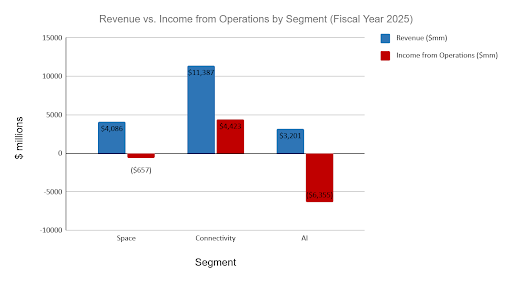
Source: SpaceX S-1 Filings
The Largest IPO in History
To fund its futuristic ambitions, SpaceX became public in the largest recorded IPO. Getting listed on the stock exchange allows for a larger pool of investors to buy into the promise SpaceX has laid out for its future. Although operating at a loss of $4.94 billion last year, SpaceX was able to raise $85.7 billion by selling less than five per cent of its shares. In comparison, the Magnificent Seven, known as a the most influential group of high-performing tech stocks in the U.S., sold an average of about ten per cent of their shares to the public in their IPO debuts.
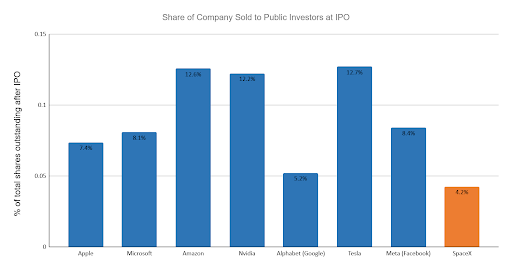
Source: Company Prospectus Filings
Since the release of SpaceX’s S-1 filing on May 20th in preparation of its IPO, investors have been scratching their heads as to how the analysts behind the deal came to the conclusion on some of the figures. For a space company, over 90 per cent of the future total addressable market (TAM) comes from the AI arm of the business. Goldman Sachs, Morgan Stanley, Bank of America, and several other major banks agreed the AI business will have a TAM of $26.5 trillion. This figure is larger than the entire GDP of the E.U. and Australia combined. As a reminder, xAI makes up less than a quarter of the total SpaceX revenue, spent nearly $13 billion dollars in capital expenditure last year, and the gap between losses and revenues continues to widen since 2024. Grok, xAI’s chatbot, has drawn criticism from generating non-consensual explicit images, yet SpaceX presents it as a product destined to be integrated into almost every business. The accuracy of the valuations backing the SpaceX IPO is beyond the scope of this article; however, these historically high figures point to a valuation resting on a belief in the distant future rather than the reality of the business today.
Fact versus Belief
George Soros argued an investor’s perceptions can influence economic fundamentals, which is part of why markets can never reach equilibrium. He called this theory reflexivity. In an efficient market, the price of a stock aims to reflect the true value of the underlying business. In a world with reflexivity, perception drives people's actions, those actions change the fundamentals, and the changed fundamentals reshape perceptions again. Reflexivity needs a storyteller, and there is no better hypeman than Elon Musk. He has spent nearly a decade insisting that a fully self-driving Tesla was “about a year away”, promising over a million robo-taxis on the road by 2020, and that humans will set foot on Mars by 2024. None of it arrived on schedule, yet the endless “for sures” and broken promises have proven convincing enough to pull in investors and make Musk the richest man on Earth. Applied to SpaceX, we can see how this theory is put in effect. Musk creates a narrative for SpaceX’s future involving travelling to Mars and putting data centres in space. The narrative pushes share prices to premium, arguably over-valued, levels. A high valuation lets SpaceX sell a sliver of stock for billions in cash, which funds Musk’s projects. These projects are then observed by the public and monitored for milestones. Progress in projects renews the narrative established initially, and the cycle repeats. This all rests on the assumption that SpaceX will achieve its goals, or at least some of them.
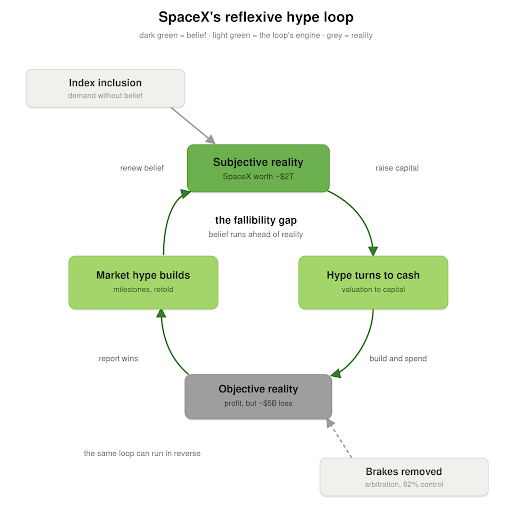
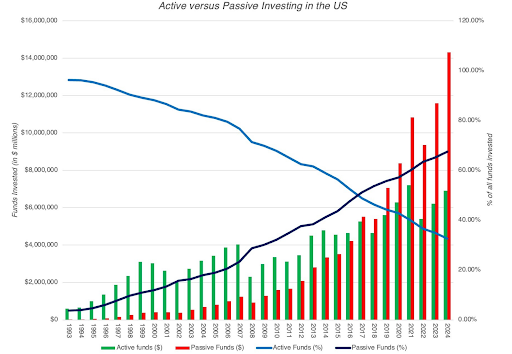
Investors may say that an overvalued stock will certainly go down, however, with SpaceX’s fast-tracked acceptance into the Nasdaq-100, its position as a top ten largest company is temporarily solidified. The goal of entering such indexes isn’t to spike up the stock’s price; in fact, over the past few decades, index inclusion has had negligible effect on performance. What’s more important is the momentum effect found in many index funds. The Nasdaq-100 is a collection of the 100 largest nonfinancial companies listed on the Nasdaq weighted by modified market cap. Companies with higher market cap represent a larger portion of the index, and funds that track this index must buy each company in proportion to its weight, sending the most money to the largest names. As more money flows in from passive funds, a disproportionate share flows to the biggest companies, creating a momentum effect letting the larger companies grow even bigger. Sitting among the ten largest names in the Nasdaq-100, SpaceX draws a steady stream of price-insensitive buying. This steady flow of share purchases helps hold the valuation up, and a sustained valuation allows SpaceX to issue more shares and convert that valuation into cash.
Source: Aswath Damodaran
We've Been Here Before
Reflexivity isn’t a new concept, nor is it unheard of in financial markets. During the run-up to the financial crisis in 2008, lenders and investors falsely assumed that housing prices would grow indefinitely and credit risk could be mitigated through diversification. As a result, credit became overwhelmingly cheap and lenders relaxed their standards to sustain high volumes. The influx of credit artificially drove house prices higher, which allowed home-owners to extract equity from their properties to increase their spending. From 2000 to 2005 the market value of existing homes rose by 50 per cent and residential investments contributed to over 15 per cent of the overall economic growth. Ultimately, the gap between artificial economic growth and unsustainable debt grew too wide, turning the self-reinforcing boom into a bust.
Why This Time Is Different
In 2008, the borrowed money funded the consumption that made GDP appear to grow. This growth, however, was not enough to justify the straining debt held by the banks and underwriters, and as delinquencies started to rise, the reflexivity loop began reversing. SpaceX’s loop is different. The capital entering the business is used to fund real projects such as rockets, satellites, and AI infrastructure. If SpaceX is able to show real progress with its goals, the fundamentals can catch up to the valuation and validate the beliefs in hindsight. This is what distinguishes SpaceX’s situation from that of 2008. It is not as straightforward to call the high valuations a bubble. In addition, 2008 was fuelled by high leverage, money that had to eventually be paid back, which is why falling prices triggered a domino effect. SpaceX, on the other hand, raises capital through selling shares, which it never has to pay back. Potential losses do not result in debt spirals or hit the banks directly. Instead, shareholders bear the burden. Musk decides when to issue more shares and how much SpaceX raises. In comparison, the 2008 leverage was spread across millions of borrowers and lenders with no one in particular steering the ship. A single player is able to time the size of each raise precisely when beliefs are high, converting the hype into cash. This creates a different risk. The entire loop depends on one man’s credibility, making it far more concentrated than the decentralized credit system of the financial crisis. In 2008, sellers were forced to sell into falling prices because of leverage. SpaceX does not face the same dynamic, but if confidence in Musk weakens, a reflexivity loop can reverse just as quickly.
Turning Valuation into Cash
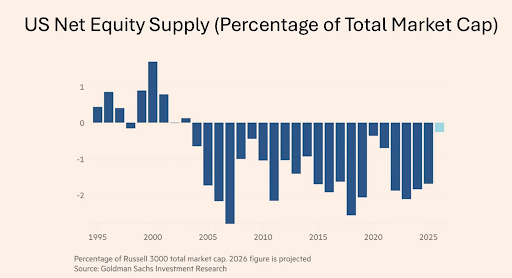
On June 2nd, Google (Alphabet) issued $84.75 billion worth of a combination of Class A and C shares alongside a private investment of $10 billion from Berkshire Hathaway. This is the largest equity raise in capital markets transaction history, and it will likely funnel into the biggest competitive field, AI. While $84.75 billion sounds like a lot of money (which it is), it only accounts for less than two per cent of the market value of the $4.5 trillion tech giant. With no significant effect on the stock’s price, Alphabet has showcased the true advantage of being a public company. This is a roadmap SpaceX will follow. May 20th, SpaceX submitted its S-1 filing, June 3rd it rereleased a second reiteration of the filing with several changes. The most notable of which was the line “We may issue a significant amount of equity in connection with future transactions”. Alphabet isn’t the only player issuing stock, in fact it has become a major trend in 2026. Total equity issuance has risen by 122.7 per cent year-over-year.
Source: First Samuel
Source: SIFMA Research
Risk of Reversal
As seen in the past, reflexivity acts as a double-edged sword. On the way up, investors are bullish, and on the way down, investors rush to sell. SpaceX’s high valuation is dependent on investor confidence and hype to continue sustaining its easy access to capital, and therefore its projects. If projects fail, demand will decrease, and a downward momentum will begin. SpaceX is one of the first of a wave. OpenAI is preparing to list at a rumoured $1 trillion while burning roughly $34 billion in expenses last year and not expected to break even until 2030. Antropic, Databricks, and Stripe are all lining up behind OpenAI, together carrying more than $3 trillion in private value. As each one gets listed, the Nasdaq 100 fills with AI names priced the same way as SpaceX, on the belief that revenue will grow a hundredfold. The index is already top heavy, with tech stocks making up over 60 per cent of the total weighting. Instead of people primarily losing their homes this time around, it will be the retirement savings and invested capital of ordinary Americans that suffer most. One reflexivity loop reversing can drag all tech stocks down with it, and this time it is the retirement savings and invested capital of ordinary Americans that suffer the most.