
Zip It and Let the Quiet Giant Speak: How YKK Dominates Global Manufacturing
Illustration by Xinyue Deng
About YKK
Look down at your pants right now. Between your legs sits a multi-billion dollar company you have never heard of. That tiny piece of metal that keeps your jeans together, your jacket closed, and your suitcase sealed belongs to YKK. Despite being attached to billions of garments around the globe, YKK remains one of the most quiet yet powerful companies in modern manufacturing. The Japanese zipper giant’s complete vertical integration, from raw materials to machinery, transformed a simple commodity into a symbol of trust and a multi billion dollar business. By internalizing every stage of production and enforcing global consistency through its Y-System, YKK secured long-term success in the market, redefining what it means to scale quality in a commoditized industry.
A Closer Look at YKK
If you have ever looked closely at your zipper, there’s a very high chance you saw the letters YKK. These letters stand for “Yoshida Kogyo Kabushikikaisha" in Japanese, which translates to “Yoshida Company Limited.” YKK manufactures roughly 50 percent of all zippers in the world; around 7 billion per year. Shockingly, zippers existed long before YKK but the brand still managed to build an unrivalled reputation in the fashion industry which they owe to their vertical integration strategy. Through vertical integration, the company is able to control every part of the manufacturing process. They have complete authority over their lead times and the quality of the products that they make. Beyond this, YKK’s strong global presence is thanks to its Y-System that gives them the ability to deliver identical products regardless of the manufacturing location. This is an essential factor that plays a role in YKK’s consistency and reliability in the fashion industry. And finally, YKK remains invisible to consumers yet unmatched in influence, proving that true success is not driven by advertising, but by trust, precision, and quality.
YKK’s Winning Strategies
Why Vertical Integration Sets YKK Apart
YKK’s dominance begins with one defining factor: vertical integration. YKK’s completely vertically integrated manufacturing system requires the production of raw materials, machinery, and finished goods in-house. Zippers are widely used around all aspects of life, giving YKK lots of competition; however, while many competitors outsource parts of the process, YKK manufactures almost everything internally including brass ingots to sliders and stops. This means YKK does not depend on outside suppliers or third-party manufacturers, enabling oversight over quality and efficiency. Additionally, the company develops its own production machinery with their own engineering group which allows them to keep their technology proprietary. This unique strategy makes it difficult for competition to replicate products at their quality standards while also reducing vulnerability to supply chain shocks. This is because when fewer external dependencies exist, YKK can better manage disruptions and maintain consistency. By completely mastering every stage of the production, YKK not only reduces defects and cost layers but also establishes a robust strategy built on precision, independence and consistency.
To better understand the scale and impact of YKK’s strategy, it helps to compare it with other global giants. YKK is quite similar to Apple in terms of its vertical integration, just as Apple dominates the tech market by integrating all its parts, YKK achieves its market strength through total control and seamless coordination across every stage of production. In contrast, however, companies like Nike, who outsource the majority of its manufacturing, often face severe supply chain disruptions that, once again, highlight the stability and resilience that YKK’s vertical model provides. By mastering every stage of the production, YKK has created a level of control that is essential for their global success. The scale of their success can be clearly exemplified through comparison with other giants in which their success is best illustrated when compared to other global giants.
The Y-System
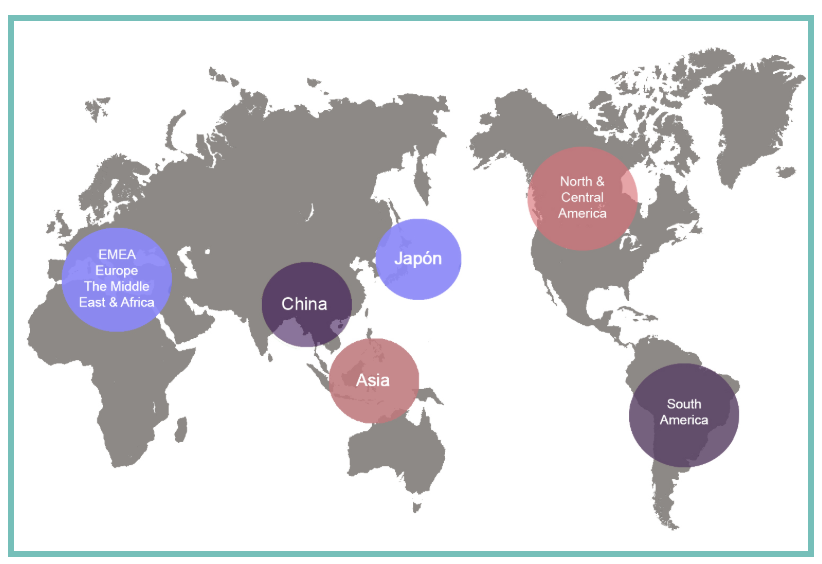
YKK’s strong vertical integration allows them to meticulously enforce the strict standards of the Y-system — another significant factor for the brand’s long-lasting success. The Y-System is YKK’s global production framework that standardizes every stage of manufacturing to ensure that every zipper produced, regardless of where in the world, meets the same standard of precision and quality. This system lies at the core of YKK’s dominance. The system is built on the principle that consistency defines credibility. Because of this, every YKK facility in the world uses identical machinery, materials, and testing methods developed in the home country of the brand, Japan. Through its unified network, YKK claims to have “achieved characteristic worldwide standardized quality” across all its operations; Figure 1 depicts all the global regions YKK operates. However, this framework does more than just guarantee quality; it acts as a strategic safeguard. By standardizing every operational variable, YKK minimizes the risk of possible outsourcing errors, supplier inconsistencies, or variations in regional quality standards. Competitors who often rely on fragmented supply chains struggle to match this level of control. Ultimately, this advantage has made YKK reliable in every corner of the apparel industry. Additionally, the Y-System strengthens YKK’s relationships with major brands. Companies like Levi’s, Prada, and the North Face continue to depend on YKK because they know that every zipper, regardless of their production location, will perform flawlessly. Essentially, the Y-System converts manufacturing a simple product into a symbol of trust. By institutionalizing quality at a worldwide scale, YKK has turned process discipline into its most powerful competitive advantage.
Invisibility
Despite being attached to billions of garments around the world, YKK remains virtually invisible to consumers. The company spends little on advertising or branding, yet its name appears on nearly every pair of jeans, jacket, or backpack. This deliberate invisibility aligns perfectly with YKK’s founding philosophy, the “cycle of goodness” which holds that “no one prospers without rendering benefit to others”. Rather than directly building recognition among consumers, YKK has focused on earning trust amongst designers and manufacturers, positioning itself as the industry’s most reliable supplier. This invisibility among consumers has become YKK’s greatest marketing strategy, giving them unspoken authority. Designers and manufacturers rely on YKK not because of advertising but because its zippers simply never fail. Thousands of brands choose YKK because its name guarantees quality making it the backbone of their reliability. Consumers may not consciously notice the YKK engraving, but its absence would likely be felt. By prioritizing dependability over visibility, YKK has redefined what it means to build a global brand.
YKK’s Lasting Legacy
YKK’s story proves that power does not always come from being seen, it comes from quality and determination. Through complete vertical integration, the company maintains complete control over its production; through the Y-System, it ensures unmatched global consistency; and through its invisible brand, it earns the trust of the world’s greatest names in fashion. YKK has achieved what only a few companies do: transforming a simple, everyday product into a global standard and quality. YKK’s success reminds us that the most enduring competitive advantage lies not in noise but mastery, in doing one thing so well that the world quietly depends on you.