
The Dinosaurs Are Dying And They Don’t Know It Yet
Illustration by Aiza Mudassar
The Dinosaurs Are Back is the title of Robert Mitchnick’s (Comm’13) article written April 2nd, 2015. In it he offers a compelling vision of humanity’s greatest threat in that year's edition of the Queen’s Business Review. A decade later, I return to his ideas to consider whether his predictions proved accurate, whether his theories remain supported, and whether we ultimately share the same ideological conclusion.
The article begins with a recount of an ‘ultra-secret’ meeting of the world’s foremost philanthropists in 2009, with the likes of Bill Gates, Warren Buffet, Michael Bloomberg, Ted Turner, and Oprah Winfrey. Each was given 15 minutes to name the issue they believed to be the most critical to the future of the planet. As Mitchnick shares, the focus of the meeting was not world hunger, climate change, or geopolitical instability. Instead, the answer was far less palatable to our sophisticated global tastes: overpopulation.
A decade later, the locus of the problem has unmistakably shifted. Overpopulation no longer stands alone. The issue is increasingly entangled with something quieter but potentially more consequential: overconsumption. The real task before humanity now is to trace how the problem has evolved, from population growth alone, to the combined pressures of demographic expansion, rising consumption, economic dependence on growth, and the limits revealed by China’s demographic experiment. One must determine why these forces, and this issue, have remained largely unspoken since that meeting in 2009, as well as what effective solutions might exist, along with whether their cost is greater than the consequences of inaction.
Ten Years On
In the decade since Mitchnick released his article, the population has surpassed eight billion people, roughly one billion more than at the time of publication. Reactions to this milestone reveal deep uncertainty about what such growth means. Jeff Bezos is one among many that embrace milestones such as these. Bezos goes so far as to say he believes we need more people and that he is actively planning how humanity can reach into the trillions. Others like Sir David Attenborough have labeled the immense population as more of a “plague on the earth.” Between optimism and alarmism lies a harder question: not simply the Earth’s maximum carrying capacity, but what kind of world an increasingly higher population creates.
Mitchnick draws on the long shadow of philosopher Thomas Malthus, which in sum explains how exponential growth will result in humanity outstripping the resources of the world under our feet. Estimates of Earth’s sustainable population have varied dramatically, largely due to the exponential growth Malthus predicts. Dr. Christopher Tucker, chairman of the American Geographical Society, and strategic advisor to the US national security community, argues that a sustainable population cannot exceed three billion. Dr. Christopher is not far off the conclusions of a 1994 Stanford research study that concluded two billion to be the ideal and sustainable size.
As of 2015, the best estimate was that we were going to reach the rather awkward milestone of ten billion people on earth by 2050—today, many forecasts place that threshold decades later. If anything, the past decade has complicated the story, suggesting that the pressures once attributed to population alone may run deeper than a simple headcount.
The Present Reality
Considered in isolation, an increase of one billion people appears striking. Placed in historical context, however, it reflects a longer expansion; from roughly three billion people in 1960 to more than eight billion today. The growth rate has actually shrunk over the past decades but as a result of the growing population the scale is, well, exponential. This decade is witnessing roughly 25 million more births per year than the last—approximately 100 million annually compared to the previous 75 million. The growth rate has shrunk from over 1.5 percent in 1960, to 0.9 percent in 2022, and is expected to decline to under 0.5 percent by 2050. A century ago, human life was far more fragile. In many parts of the world, average life expectancy hovered around forty years, and childhood mortality was a common and devastating reality. Today, global life expectancy exceeds seventy years, and billions more people survive infancy, disease, and famine than at any other point in history—that is a large part of how humanity has surpassed the 8 billion people mark. Living standards, by nearly every measurable dimension, have been transformed.
Beyond counting ourselves lies a deeper inquiry: what is becoming of the far more numerous inhabitants of the natural world with whom we share this planet? Current global assessments suggest one million species are at risk of extinction; an unprecedented threat to the natural world order. The decline is indicative of not only ecological fragility but instability of our food, water, and climate systems. The uncertainty around the human population remains, but that of the biosphere itself remains far more certain and far darker.
The alarm bells are sounding not only for wildlife activists and ecological experts. The effects are increasingly felt within human societies themselves, including the densely populated cities where much of the world now lives. From Rio de Janeiro to Mexico City, and even to megacities like Tokyo, environmental “shocks” are becoming less exceptional and more routine features of daily life. Over the past four decades, the number of climate and environmental related shocks severe enough to threaten large populations has more than tripled. Environmental shocks are unexpected events that originate from natural or anthropogenic sources that cause significant, immediate disruption to ecosystems and human social structures; being anything from earthquakes to a Chernobyl level catastrophe. Events once considered exceptional are now becoming a regularity in the global landscape. The toll, measured both in financial loss and human life, is already immense. At the same time, shifting patterns of security, migration, and climate exposure are generating new pressures that strain political systems and social cohesion alike.
The pressures long associated with climate change, or overpopulation as Mitchnick points out, cannot be understood through any single trend in isolation. These threats are no longer abstract projections of future scarcity; this is the reality of what is unfolding, unevenly, but unmistakably, in the present.
An Expanding Problem
Mitchnick cites an essay on the Principle of Population, in which the author postulates that “the power of population is so superior to the power in the earth to produce subsistence for man, that premature death must in some shape or other visit the human race.” This article posits that premature death will emerge not from overpopulation in and of itself, but from its entanglement with overconsumption.
Humanity is a remarkable force we have proven capable of reshaping landscapes, economies, and ecosystems on a planetary scale. The same capacity that fuels prosperity now risks consuming the ecological cradle of civilization, placing demands on the Earth that cannot expand indefinitely. The global GDP has grown by a factor of ten since 1960; and by 2050 the global GDP is expected to double again, or so says PWC. The global GDP therefore should be expected to grow by a factor of just under seven from 2050 to 2100. Cumulatively,that means the global GDP will have grown by a factor of over 65 from 1960 to 2100. The resources required of Earth in order to sustain that growth is simply immense. The question Mitchnick poses on behalf of the 2009 meeting attendees now must be reframed as: not only how many people the Earth may support, but how much material transformation the collective prosperity will require.
Seen in this light, the Malthusian principle, an explanation of exponential growth, re-emerges not simply as a question of numbers, but of exponential scale. Humanity is consuming a massive amount of resources and the collective demand has expanded dramatically. That expansion is driven not only by population, but by the material intensity of individual lives, an intensity that is 70 percent higher in advanced economies. Further, due to wealth disparity and a growth in luxury consumption whether measured in aviation, real estate, or material throughput reveals a deeper asymmetry: ecological strain scales not with population alone, but with concentrated wealth. Since 1960, per capita consumption has increased roughly fourfold. What was once the privilege of advanced economies, and earlier exclusively the rich, is becoming an aspiration in many developing nations globally. Continued expansion in emerging markets is resulting in higher incomes, longer lives, and secure standards of living for a growing share of humanity. The economic growth now seen suggests that the material expectations of prosperity may soon be widespread rather than exceptional. Moreover, as life expectancy rises and spending power grows, so too does the capacity for consumption. McKinsey researchers responsible for that assessment further purport that there are no insurmountable physical barriers to universal prosperity. The lack of physical barriers and the increasing rate of growth is one that can, at present time, be largely attributed to the rise of artificial intelligence and technology.
The strain placed on the planet is not simply a function of how many people exist, but of how wealth, production, and consumption scale alongside them.
Population as Power
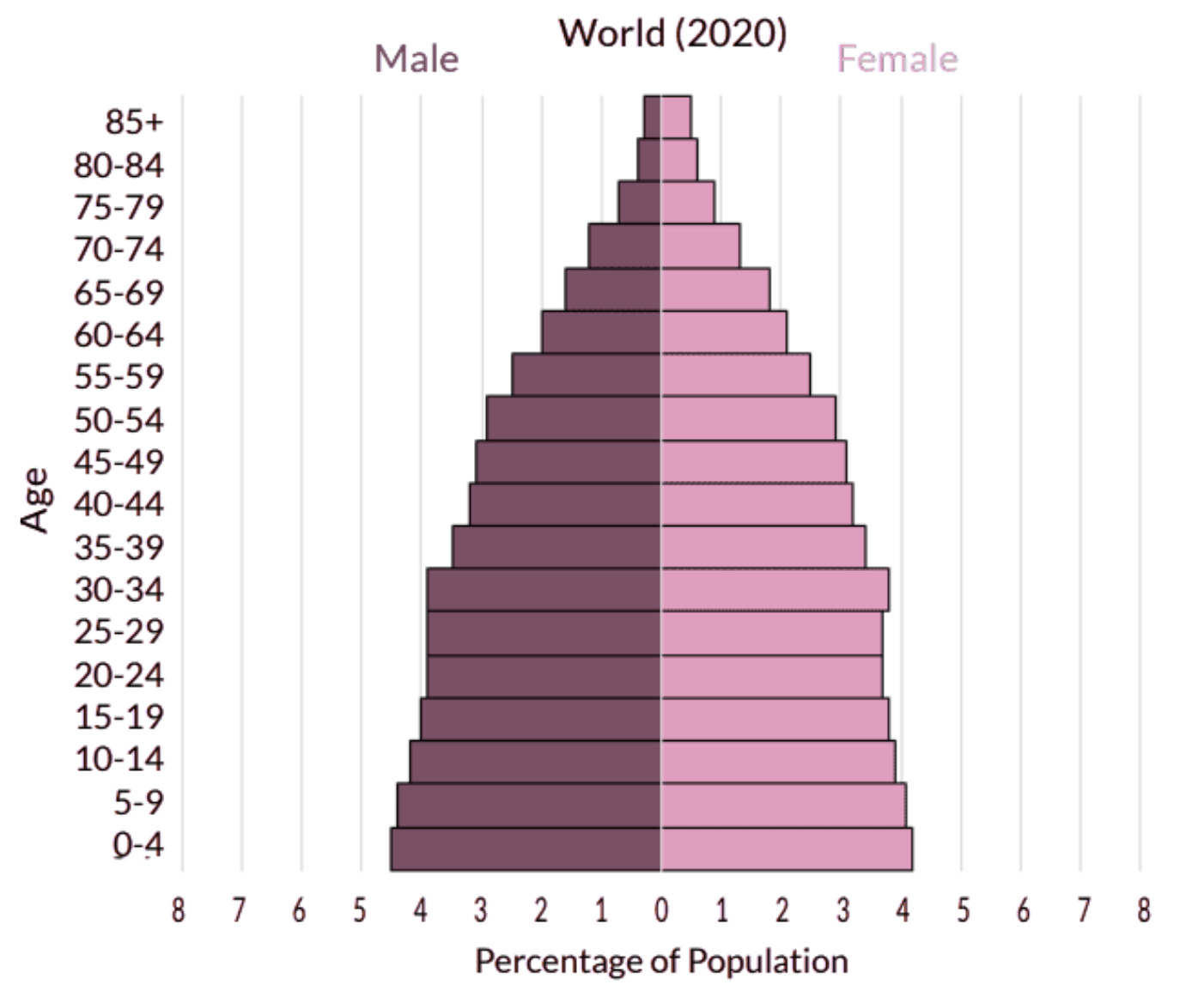
Many are familiar with the population pyramid, a chart showing the population size from youngest at the bottom to the elderly at the top. This is the global chart from 2020, you can see a healthy population, majority in the working ages from 15-64. In this case the population does form a pyramid, growing narrower the taller or older, the data gets on the chart. However while this chart appears healthy, the reality is the population pyramids for different countries vary greatly. Look no further than Japan, whose pyramid is inverted, leading to economic strain and long term concerns regarding overall stability. The economic significance of population becomes clearer when viewed through a pyramid such as this. Societies with broad younger generations and smaller elderly populations benefit from expanding workforces, a rising tax base, and when the population is on the younger end, it signals momentum that sustains long term growth. By contrast, an inverted pyramid, like Japan, places a sustained pressure on productivity, public finances, and social welfare systems—overall momentum is arrested, the tax base shrinks, and the labour capacity is diminished as workers pivot to support retirees. In this sense demographic structure, not merely population size, determines the trajectory of national prosperity and decline.
The world has largely transitioned from agrarian economies and can now be labelled as early industry economies. The main indicator of an early industrial economy is the rise of factory systems and the manufacturing industry as well as urbanization. There is a tight correlation between manufacturing success, cheap cost of goods, and a large working age population leading to swift economic growth; countries such as India or Bangladesh, names you may find on tags of clothing you have bought, support this theory. Economic growth is the most clear value of demographic expansion visible in the history of industrialization. Countries that rapidly moved up the developmental ladder and through the industrial economy stage typically did so with large young populations able to supply the abundant low cost labour the manufacturing sectors require. The competitive labour costs these economies were afforded supported export growth and capital accumulation. This allowed economies to transform from agrarian subsistence toward industrial productivity and eventually higher income status. Population growth here does not function as a burden in emerging economies but instead as the underlying engine of economic transformation.
Napoleon famously said “China is a sleeping giant. Let her sleep, for when she wakes, she will shake the world.”
In the decades following the 1978 reforms, China emerged as a transformative force in the global system. Nowhere was this more evident than in industry, where its meteoric rise disrupted established economic hierarchies and generated a shock that continues to shape globalization’s economic and geopolitical contours in the present day. Prior to 1978, China’s economy was organized around agriculture and central planning, with development directed by the state. Economic reforms initiated after 1978 first transformed the rural sector by allowing farmers to lease land, sell surplus output, increasing productivity and income. Prosperity in rural China increased enterprises in townships and villages which emerged around 1980, this marked the true beginning of an industrial China; many of these enterprises were largely privately owned and expanded industrial production while stimulating urbanization. As market activity spread, the share of industrial output produced by state-owned enterprises declined substantially, while private and non-state firms became the primary drivers of manufacturing growth. The creation of Special Economic Zones and expansion of foreign trade participation, further scaled industrial production toward export markets, completing China’s transition from a predominantly agrarian system to a manufacturing-based and globally integrated economy.
Taken together, the logic is difficult to ignore. Demographic expansion has not merely accompanied economic development; it has repeatedly enabled it. Young and growing populations have supplied the labour that fuels production capacity, powers industrialization, and lifts nations up through the developmental ladder. Emerging markets in developing nations around the world have recognized this trend, taking advantage of the rewards expansion, growth, stability, and geopolitical influence increased industrialization affords. Population expansion paired with economic advancement creates a reinforcing system in which aggregate consumption grows alongside a rising consumption per capita. The result is a global economy structurally oriented towards more people and more consumption, an orientation whose consequences are only now beginning to unfold.
The ‘Obvious’ Solution
China’s one-child policy stands as perhaps the largest demographic experiment in human history, and likely the most obvious solution to halting a population boom in the most immediate way possible. Introduced in 1979 to curb explosive population growth, this “one child” solution restricted most families to a single child. The government enforced it through strict measures: couples who exceeded the limit faced heavy fines, loss of welfare benefits, and even forced abortions or sterilizations in extreme cases. In the short term, the policy achieved its immediate goal. China’s birth rate plummeted and population growth slowed dramatically, officials even credited the policy with preventing up to 400 million births. By the end of the 20th century, China’s fertility rate had fallen below replacement level, seeming to avert the Malthusian fears of overpopulation straining resources. This dramatic decline in births was initially hailed as a socio-economic boon, easing pressure on food supplies and helping fuel China’s economic rise by concentrating resources on smaller younger generations that had a greater economic contribution through labour and education.
Over time, however, the one-child strategy worked too well, producing a new set of daunting challenges. Decades of artificially low birth rates have left China with a rapidly aging population and a shrinking workforce. In other words China’s population pyramid that is not yet but starting to, become inverted; this reversal now threatens the country’s long-term prosperity. Socially, the policy skewed China’s demographics: a cultural preference for sons led to selective abortions or adoptions of girls, skewing the sex ratio toward males by an estimated 4% more men than women, (on the Chinese scale that is a 35 million person discrepancy). This gender imbalance has resulted in millions of “missing” women and a surplus of unmarried men, reshaping family dynamics. Economically, the once-lauded population control now presents a looming crisis. Fewer young workers are available to support an expanding elderly cohort, and by 2050 over a quarter of Chinese citizens will be over 65, more than double the proportion just a few years ago. The strain on pensions, healthcare, and the labor market is growing evident as the demographic dividend that powered China’s growth flips into more of a burden than a boon. Recognizing these unintended consequences, Beijing formally ended the one-child policy in 2015. Families are now allowed, and even encouraged, to have two or more children, with new incentives like tax breaks and extended parental leave. After nearly 35 years of one-child norms, reversing the demographic tide has proven difficult. China’s “one-child solution,” once seen as a bold answer to overpopulation, has thus transformed into a cautionary tale, a reminder that population control can carry complex social and economic costs of its own.
With the decade since the policy’s end we have the benefit of many years worth of demographic and economic evidence to evaluate the policy in its entirety. The balance of this judgement has shifted from Mitchnick's original assessment, while he was correct that the policy’s immediate consequences were visible and severe, he argued its positive impacts would emerge in the long-term and were therefore difficult to quantify; as a result the policy had been widely vilified. A decade of hindsight complicates that view. The same intervention that effectively curbed the short-term population boom has produced medium and long term structural strains. Aging, a shrinking labour pool and, fiscal pressure, threaten the very prosperity China achieved through the use of cheap labour. They have effectively curtailed that risk through achieving a more advanced economic state, but their policy on population growth remains increasingly aggressive. China now incentivizes larger families, serving as the clearest signal of their shifting policy. With the one-child policy in the rearview, what was once framed as a difficult but necessary solution now appears more of a transformation from one demographic crisis straight into another.
Viewed in retrospect, China’s one-child era represents more than a national policy experiment; it offers a rare glimpse into the demographic limits of modern economic and political systems. An intervention designed to restrain explosive population growth succeeded in its short term goals, yet in doing so produced labour contraction and fiscal strain that now threaten long-term stability. The lesson is not simply that one policy failed, but that no single demographic configuration appears capable of sustaining prosperity indefinitely. In this sense, China’s experience appears less exceptional than anticipatory, an early signal of a broader dilemma emerging across the global economy, one many countries will be forced to face. Namely this raises questions as to what countries in Asia and Africa with currently booming populations, encouraged politically in order to further economic growth, will choose to do once they face the same problems as China in 1979.
An Uncomfortable Discussion
Overpopulation being an uncomfortable discussion was something Mitchnick directly addressed, and it’s something that remains true today. Similar to the outlook on China’s one child policy, the short-term effects are what society fixates on; allocating the majority of our emotional, social, and political capital towards. However, when discussing the issue most critical to the world at large we must look beyond first-order effects. The reduction of hunger, the fight against disease, and the alleviation of poverty are aims beyond reproach in their moral nobility. In the saving or improvement of lives, an indisputable good is realized. Yet in the context of overpopulation and overconsumption, where lives are not being saved or as per some solutions even prematurely ended many people find addressing the issue unpalatable, and rightfully so.
Mitchnick purports that the aversion to addressing this issue is misguided, because the addition of one billion marginal lives into the world is likely to result in greater collective misery due to existing over-crowding. Yet I find myself at odds with this conclusion because it relies on the assumption that the addition of more marginal lives results in misery for the collective, ignoring the benefits and solutions we now see as a result of unique individual greatness. That the world is overcrowded is another assumption I find myself questioning. If we are to believe Sir David then yes the world is overcrowded, but when considering recent UN reports I find the two schools of thought contradictory. One must admit that while the planet is heavily populated, humanity has not reached overcrowding in any purely spatial sense. Earth Overshoot Day (which we have reached), the theoretical day in which consumption concretely surpasses the Earth's supply, does not mark the moment when the planet runs out of room, but the moment when human consumption surpasses the biosphere’s capacity to regenerate. The constraint we face is therefore not geometric but ecological. The Earth is not full of people; it is full of demand. This distinction matters, because it shifts the crisis away from the mere number of human lives toward the intensity with which those lives transform the world around them. It is not inaccurate to say that when we started ‘celebrating’ Earth Overshoot Day, we started a clock. We are consuming faster than the ecosystems around us regenerate, humanity must ready itself for the clock to hit zero and there are no longer any more resources to consume.
Mitchnick considers the fear and resistance people have towards any policy that controls population; viewing it as a violation of human liberty, specifically the right to reproduce. He makes the case that there is an irrational prejudice against confronting overpopulation, and I disagree, thinking that prejudice is quite rational once you understand that humanity is inherently prejudiced against everything. In this case when discussing something as intimate as reproductive rights, there is an inherent bias. For a recent example of the outrage issues such as this cause look no further than the right wing ideology sweeping the world that is largely based on a prejudiced mentality. That can simply be fiscally conservative or a prejudice concerning reproductive rights themselves
I find myself agreeing with Mitchnick on a very specific point: he compellingly argues that the preservation of individual liberties cannot supersede the survival of the collective. How can an individual choice be justified when humanity itself faces an existential threat? This is, by all accounts, an uncomfortable truth—one few are willing to acknowledge. Yet it must be confronted openly, for only through honest discussion can we begin to address the peril facing humanity. We cannot allow further ultra-secret meetings like the one in 2009. We must foster transparent and public conversations aimed at confronting the underlying drivers of global crises, namely overpopulation and overconsumption; these in turn intensify climate change, financial strain, and ecological collapse.
A decade ago Mitchnick was asking the right questions, proposing solutions to the right problems. Today, the problem is not merely how many we are, but also how we live. I would argue that overconsumption is a comparably unpalatable subject. In today's age of mass consumerism, such an activity is akin to a civil liberty and I would expect a similar level of prejudice to the mere suggestion that individuals reduce their consumption for an ambiguous and selfless reason such as collective good. Here, I echo Mitchnick’s sentiment: such concerns are ultimately outweighed by the peril these issues represent, and therefore the solutions required must also supersede the prejudices that obstruct them.
Saving Humanity
“We are experiencing the endgame of empire, the time when Earth can no longer feed the rapacious appetite of imperial powers or support the paradigm of unlimited growth.”
Waziyatawin, a prominent academic and activist in the Indigenous space, warns that the end of empires is approaching, arguing that the twenty-first century is defined by a convergence of human made crises: climate disruption, resource depletion, ecological collapse, and population pressures. These together form an unprecedented storm. As an Indigenous author, she argues for an Indigenous resurgence which is a living archive of land-based practices, stewardship, and restraint. Resurgence represents various ways of organizing human life around relationship and reciprocity rather than extraction. A balance between consumption, and stewardship. However this solution is shaded by a dark paradox on the horizon: if action is delayed long enough the damage may become so complete, that no return to stewardly ways will fully restore the irreparable damage that has occurred. Hope remains real, but not infinite; we are bound by ecological thresholds that we actively approach, we are bound by time.
The United Nations advances an alternative solution, one Mitchnick argued a decade ago was too slow with a decade of hindsight and research I believe his postulation has proven correct. The UN proposes that access to education and healthcare, particularly for girls and women, will lead to a gradually lower birth rate and slow the growth of humanity. The UN goes further to discuss conservation of natural resources, but they also specifically call out the need for lower consumption lifestyles, while lacking the specificities required in order to accomplish such a lofty goal. Importantly, the UN recommends in strong terms to governments and other bodies around the world to employ AI in developing resource conservation plans and to solve other problems where an optimality can be clearly identified. The twenty-first century means facing the ‘perfect storm’ but it also means we are equipped with technology to challenge it. Although humanity may possess the technological and institutional tools required to avert ecological collapse, that has not yet been proven; even if every tool were used and global cooperation were perfect, the outcome could still fall short.
To Mitchnick's point, political systems systematically discount long-term collective benefits in favor of short-term visible gains, often in a selfish manner, preventing the global or even national coordination necessary to act before irreversible thresholds are crossed. Mitchnick goes a step further in his 2015 article, proposing that development assistance should be tied to measurable reductions in fertility rates. He argues that education alone is insufficient without structural incentives for demographic change. A system such as this would leave countries funding from the World Bank and the IMF dependent on demonstrated progress towards specific population targets. This raises significant ethical concerns, and likely would not garner the political support needed to gain global traction.
Every effective solution to the overpopulation, and the overconsumption problems will be as Mitchnick put it, rather draconian. I see the solutions, at the very least, as severely unpopular to the point of infeasibility. The world is a decade closer to extinction and the world must come to grips with the events that are unfolding in the present. A plausible solution seems to be to focus our energy on reducing the consumption of the class that consumes the most, those that practice luxury consumption. Reducing luxury consumption aligns with the Occam’s Razor, the idea that the simplest answer is the correct one. One must realize that those with concentrations of wealth would be the most affected by such a policy, and subsequently most adverse to any policing of such consumptionism. Unfortunately in the present state of society, no solution effective enough to make an impact seems concretely feasible.
Time is Running Out, Again
What emerges across these perspectives is not a single failed policy or insufficient technology, but a deeper structural dilemma. Confronting overpopulation directly has become morally unthinkable, bound to questions of liberty, coercion, and the sanctity of human life. Confronting overconsumption, by contrast, is politically unrealistic, requiring limits on prosperity, growth, and the material expectations upon which modern economies depend. The crisis therefore remains largely unspoken not because it is poorly understood, but because its true remedies are blocked simultaneously by ethics and by power.
The threat is catastrophic, and the cradle of civilization is on fire. When faced with the prospect of humanity dying en masse due to starvation, disease, ecological changes, and geopolitical instability, the seemingly harsh remedies start to appear far more of a necessity.
Reading Mitchnick's article, and evaluating the events that have unfolded in the decade that has followed leaves me deeply dissatisfied. Influential figures identified what they believed to be a defining threat, yet meaningful structural change has not followed. The conversation stalled where it began. Action must be taken, we simply cannot deny development to nations as Mitchnick proposed; the path forward does not lie in restricting growth where prosperity has not yet been secured. Instead, it lies in confronting the consumption patterns of advanced economies—the per-capita excess that quietly multiplies global exponential strain. As Canadians we recognize and appreciate the value of the land we reside on, that is evident in every land acknowledgment we hear, but to embody that acknowledgement means acting in stewardly fashion. Currently our declarations of stewardship remain hollow, land and resources are extracted en masse. To embody acknowledgment requires reciprocity rather than extraction, preservation rather than perpetual consumption. We are called out of necessity to lead a resurgence of our own. Focusing on reciprocity, focusing on preservation; halting the practices of over extraction and overconsumerism.
Waziyatawin speaks of “waiting for the end of the empire.” If that end comes too late, the damage will already be done. Yet extinction is not foreordained. The alternative is indeed a resurgence as Waziyatawin conveys—not of Indigenous people per se, but of an Indigenous ethos. A decade of hindsight clarifies one truth: the solution is not abstract. It begins in the ordinary choices of affluent societies. Stop replacing your phone every two years. Multiply that restraint across millions, and the personal change can become structural.
I echo the question Mitchnick posed just over a decade ago: The question for our global community today is: when that crisis comes and the world is finally willing to act, will it be too little, too late? Yet a more unsettling question now stands beside it, might that crisis no longer lie in the future, but already be unfolding in the present?