
I Know What You Paid Last Summer: Examining How Wall Street Is Underestimating AI's Latest Trick

Illustrated by Mara Chintea
Look at almost any equity research report on retail or consumer platforms from the first half of 2026, and you will likely find a familiar buy thesis: artificial intelligence dynamic pricing is guaranteed to expand operating margins. At first glance, extracting maximum margin from every single transaction using hyper-individualized surveillance data appears to carry no workarounds and virtually no structural cost. Yet In spite of this optimism, the pricing-technology vendors selling these tools cannot agree on what the capability is actually worth. McKinsey & Company cites average margin improvements of five to ten percent from AI-integrated pricing engines (McKinsey & Company). Another puts the figure at a gross margin lift of roughly one to three percentage points in categories with meaningful elasticity variance (RetailGrid). A third claims margin gains of up to ten percent alongside a thirteen percent increase in sales during peak periods (Master of Code). None of these figures share a methodology, and none appear to have been reconciled with one another by the analysts citing them.
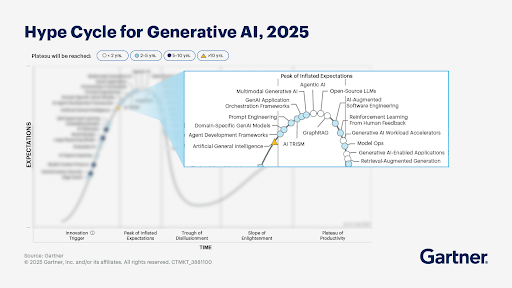
Gartner’s 2025 Hype Cycle places GenAI-enabled applications at the apex of "Inflated Expectations"
Financial markets have, twice within the past three decades, priced a genuinely novel revenue stream as though it were stable when its underlying value was in fact contingent and poorly understood by the analysts modeling it. Late-1990s equity research treated internet advertising revenue as a durable multiplier on user growth, even going as far as to coin metrics such as “price-to-eyeballs” to justify valuations that had no connection to profitability. It is not incidental that the surveillance-based advertising infrastructure built to fuel that boom became the technical and commercial ancestor of the data-driven pricing systems now being deployed in grocery stores and airline booking engines (Market Histories; University of Minnesota Press, Profit Over Privacy). A decade later, mortgage-backed collateralized debt obligations (CDOs) were issued on the assumption that geographically-diverse pools of subprime debt would default independently of one another. The Financial Crisis Inquiry Commission later concluded that this correlation assumption was simply wrong, and that CDOs issued in 2005 and 2006 were systematically underpriced for the risk they carried (Knowledge at Wharton). While surveillance pricing is not a securitized instrument and will not trigger a systemic event on its own, it shares the same underlying error with both of its predecessors: a revenue stream that is fundamentally contingent on regulation, on an uninterrupted flow of personal data, and on consumer trust (that the practice itself steadily depletes), is being modeled as though it were as sustainable as a subscription fee or price markup business model.
Real-time price adjustment (also called dynamic or algorithmic pricing) replaces fixed price tags with automated software that changes prices instantly. Algorithms analyze live data such as surges in demand, browser history, or location, and automatically calculate a customized price at the moment of viewing or checkout to capture the highest amount a specific customer is willing to pay (Canadian Competition Bureau).
Classical economists have long distinguished between degrees of price discrimination, with first-degree, or "perfect," price discrimination describing an extreme in which a seller captures the entire consumer surplus by charging each buyer exactly the maximum they are willing to pay. For most of history this has remained theoretical, constrained by the seller's inability to actually know each buyer's reservation price. Surveillance pricing is the first practical infrastructure to close that information gap at scale, which is precisely why it is so attractive to margin-focused equity analysts and precisely why it invites the level of scrutiny detailed below.
A Regulatory Foundation That is Still Being Poured
The global market for electronic shelf labels, the digital tags that allow a retailer to change a shelf price in seconds rather than dispatching an employee to swap a paper tag, was valued at approximately $2.09 billion in 2025 and is projected to reach $7.32 billion by 2033 (Yahoo Finance, citing Grand View Research). Walmart alone is extending the technology across its entire US store footprint, applying it to roughly 120,000 items per location and reducing the labour time associated with price changes by as much as seventy-five percent (eMarketer).

As highlighted in "The Friday Checkout," electronic shelf labels like this one allow retailers to update pricing instantly across thousands of products (Grocery Dive).
In April 2026, Manitoba became the first jurisdiction in Canada to prohibit what its Business Practices Amendment Act defines as predatory pricing on groceries. Days later, Ontario Premier Doug Ford added that he would pursue retailers aggressively if evidence of collusion emerged (Global News). That same week, the federal New Democratic Party introduced a motion in the House of Commons seeking a national ban, with leader Avi Lewis describing the practice as "a dystopian practice that will drive up costs for Canadians," and MPs voted the motion down (CBC News; X). Two provinces reached opposite conclusions within days of each other.
On April 28, Maryland Governor Wes Moore signed the Protection From Predatory Pricing Act, making Maryland the first US state to restrict surveillance pricing in the food industry outright, with penalties of up to $25,000 per violation for repeat offenders; the law takes effect on October 1, 2026 (Skadden Arps). New Jersey and Pennsylvania have comparable bills advancing through committee, and New York already requires point-of-sale disclosure whenever a price has been set algorithmically using a consumer's personal data. California's Attorney General opened an investigative sweep of the retail, grocery, and hotel sectors in January 2026 to examine how personalized pricing models intersect with the state's existing purpose-limitation privacy law, and a pending state bill would prohibit surveillance pricing outright, with civil penalties of up to $12,500 per violation and triple that amount for violations found to be intentional (Fisher Phillips).
None of these jurisdictions are coordinating with one another, and none appear likely to converge on a single standard in the near term. For a retailer operating across state and provincial lines, this implies compliance costs and litigation exposure that vary by jurisdiction on a timeline set by whichever legislature is next up for election, which is a materially different risk profile than the one implied currently predominant valuation models. This CapEx does not depreciate gradually according to a predictable schedule; it is written down to zero on the day a bill takes effect.
The Fragility of the Underlying Data Architecture
Surveillance pricing depends on an uninterrupted, high-fidelity (i.e. minimal distortion) firehose of personal data spanning browsing history, location, device type, and prior purchase behaviour, in order to function at all. If consumers opt out, the algorithm loses all of its fuel in one fell sweep.
Economist George Akerlof's 1970 model of the market for used cars, commonly known as the "lemons" problem, described a market in which sellers know more about the quality of their product than buyers do, thereby worsening the market's overall efficiency (dubbed “information asymmetry”). Surveillance pricing reverses that asymmetry because now, the seller now knows more about the buyer, specifically the buyer's willingness to pay, than the buyer knows about the price being offered to anyone else. As consumers become aware of this reversal, a growing number are taking the same evasive action that privacy-conscious car buyers once took toward sellers: clearing cookies, opening private browsing sessions, using private virtual networks before making a purchase, etc. The advice to do exactly this became common enough that when a JetBlue social media account suggested a customer "clear cache and cookies" after he complained that his fare had risen $230 in a single day, the exchange went viral and became a central piece of evidence in a subsequent class-action lawsuit (Mayer Brown). Even in jurisdictions where surveillance or personalized pricing are not itself illegal, collecting the underlying data without adequate consent will not fly in any reasonable court of law today.
Goodhart's Law is the observation that once a measure becomes a target, it ceases to function as a reliable measure. A pricing algorithm calibrated on the assumption that browsing behaviour reflects a consumer's authentic preferences becomes unreliable the moment a meaningful share of consumers begin deliberately falsifying that behaviour to obtain a lower price. Today, independent of any new surveillance-pricing-specific legislation, California's purpose-limitation principle under the CCPA restricts a business's use of personal data to purposes consistent with a consumer's reasonable expectations. Meaning, if a consumer plausibly expects a delivery address to be used for shipping, but does not expect browsing history to be repurposed to calculate the maximum price they will tolerate, firms doing so without clear disclosure may already carry legal exposure (Faegre Drinker).
Not to mention, generating thousands of individualized price calculations per second across a national store footprint is live infrastructure dependent on continuous uncorrupted data pipelines and a model that has not drifted into nonsensical output or hallucination. A single outage in that infrastructure for a physical storefront whose pricing logic depends entirely on a real-time system can lose the ability to transact altogether at precisely the moment a competitor's static price tag continues to function normally. This risk is difficult to reconcile with a valuation model that assumes the associated margin gain persists quarter over quarter without fail.
The Erosion of Terminal Value
The JetBlue incident spread as quickly as it did because it confirmed consumers' suspicion that the price displayed on their screen was not a fixed fact about the product, but an inference about what they could be induced to pay. Once a customer internalizes that distinction, they are no longer comparison-shopping between products; instead, they are attempting to outmaneuver a company's estimate of their own willingness to pay. This is an adversarial dynamic, rather than one grounded in customer loyalty.
This shift in perception is already visible in public response, though it is well ahead of any measurable effect on quarterly earnings. The United Food and Commercial Workers International Union launched a national campaign in February 2026 explicitly targeting what it calls the predatory practice of surveillance pricing, and legislation modeled on the union's campaign has since been introduced in New York, Oklahoma, Washington, Arizona, Nebraska, Maryland, and Tennessee (Grocery Dive). Labour groups have drawn an explicit comparison between electronic shelf labels and the surge pricing consumers already associate with ride-hailing platforms. This is a comparison designed specifically to transfer an existing negative association onto a new practice before most shoppers have encountered it directly (Buffalo Toronto Public Media).
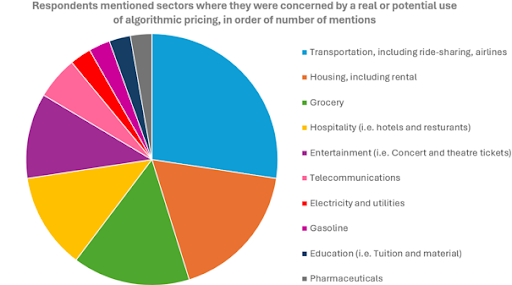
Public and industry consultation feedback on algorithmic pricing measures from January 2026 (Competition Bureau of Canada).
Harvard Business School scholar Shoshana Zuboff's concept of "surveillance capitalism," which describes an economic order in which behavioural data extracted from consumers is converted into prediction products and sold in what she terms “behavioural futures markets,” has by 2026 become sufficiently mainstream that its vocabulary now shapes how legislators and labour organizers describe the practice (Harvard Business School). Although defeated in April by a Parliament with just six sitting NDP members, the federal motion still managed to call these company practices "creepy," "a rip-off," and an attempt to "spy" on consumers.
Equity research relies on the concept of terminal value (the assumption in most valuation models that a company's cash flows persist indefinitely because customers continue returning to it). Surveillance pricing, contrarily, is designed to extract the maximum possible value from a single transaction with a customer who, once aware of the mechanism, is measurably less likely to trust the product and its displayed price again.
Pricing the Risk Correctly
None of the preceding arguments are claims about whether surveillance pricing is fair to the person buying groceries or booking a flight. That question is already being litigated in the press, in provincial legislatures, and on social media, and it deserves the attention it is receiving. It is, however, a distinct question from whether this represents a sustainable earnings source, and at present almost no one on the buy side is interrogating the second question with the vigour applied to the first.
Analysts must not fully stop modeling AI-enabled pricing as a contributor to margin. They must, however, stop modeling it as a costless one. CapEx built on infrastructure that a state legislature can render non-compliant within a single fiscal year belongs in a different risk category than a loyalty program. A revenue model dependent on a feed of personal data that a browser setting can interrupt and purchased through the erosion of consumer trust does not carry the same certainty as a subscription-based revenue stream, in spite of how similar the two may appear on a discounted cash flow statement. Until buy-side models begin applying a meaningfully higher discount rate to this category of earnings, the current valuation premium assigned to AI surveillance pricing rests on the same kind of confidence that has, twice before, not survived the next cycle.