
Fashion’s Biggest Night: How the Met Gala Fuels the Fashion Industry
Beneath all the glamour and gowns, the Met Gala isn’t just a celebration of fashion, it is a calculated playbook. Behind every dress is a strategy, behind every partnership is a calculated ROI, and behind every red carpet is a multi-million dollar marketing campaign. Each year, thousands of designers and luxury brands come together to leverage the Met Gala as a strategic tool for brand positioning and commercial gain. This article explores how brands use the event as a high-impact marketing model to better position themselves, analyzes artist-brand collaborations on a cost-return perspective, and its effect on mass retail and resale markets.
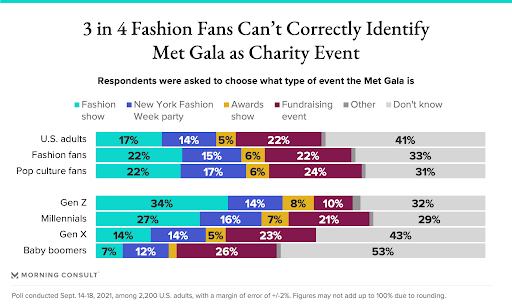
Each year, on the first Monday of May, the Met Gala brings together the most renowned celebrities at the steps of the Metropolitan Museum of Art in New York City, as a fundraiser for the museum's Costume Institute. For years, the event, hosted by Anna Wintour, has raised eight-figure sums. However, what initially started out as a fundraiser quickly became the biggest night in fashion. The tickets that were once $50 in 1948 now cost $75,000. Moreover, as the fashion designers were expected to interpret a theme, the Met Gala opened up a perspective that was more about creativity and expression than fundraising. This especially took a big jump when former Vogue editor Diana Vreeland, joined the Met Gala team in 1972 as a special consultant and helped with the evolution of the Met Gala into a grander affair. With that, the intentions and the purpose of the event have shifted; it is now more about cultural capital, brand exposure, and strategic positioning than pure philanthropy. In the graph below, published by Morning Consult, it becomes clear that the Met Gala is not perceived or known as a fundraising event by the general public.
Turning the Red Carpet into a Runway for Brands
Consumers cannot buy a ticket to go to the Met Gala, but they can buy a product that makes them feel like they are a part of it. Knowing this, brands strategically position themselves and their products to take advantage of the opportunities that the Met Gala offers to increase their sales – a practice known as experimental marketing. This calculated branding exercise serves a purpose, as can be seen through the sales that hit the roof post-Met Gala this year. According to Vestiaire Collective, a leading second-hand designer marketplace, many luxury brands experienced a notable spike in sales immediately after the 2023 Met Gala. For instance, Mark Lagerfeld sales rose by 48 per cent, Chloé by 72 per cent, Fendi by 35 per cent, Miu Miu by 17 per cent, and Valentino by 23 per cent. Additionally, due to the sheer dress trend that sparked at the 2023 Met Gala, reports indicate a 110 per cent increase in Google searches for “see through dress trend,” alongside a 200 per cent increase in Google searches for “what to wear under a sheer dress?”. All of this is driven by media exposure; according to Forbes, the Met Gala generated over $552 million in media impact value in 2025 with an engagement rate of 8.5 per cent on Instagram alone. From a strategic lens, this suggests that brands don’t need to rely on traditional ad placements, such as billboards, flyers, or television commercials to generate demand.
By investing in the Met Gala, they earn media visibility which consequently leads to media exposure, trend authority, and consumer engagement which is difficult to replicate through traditional campaigns. Essentially, the Met Gala functions as a highly efficient brand-recognition catalyst, a driver for “unpaid” media visibility, and a demand generator due to offering experimental marketing techniques. Experimental marketing distinguishes itself from traditional marketing as it prioritizes consumer engagement, emotional connections, and personal experiences, leading to a more memorable and efficient way of marketing. It is safe to say that brands investing in the Met Gala are able to drive sales in an untraditional way.
Understanding the Artist-Designer Relationships Driving Iconic Met Gala Looks
Some invest in stocks, others in bonds, but for designers, dressing a celebrity at the Met Gala can yield the highest return of all. Brands deliberately choose artists whose public image, digital reach, and cultural relevance align with their commercial objective. A great example of this is Zendaya, who is long styled by image architect Law Roach and demonstrates the high-return potential of a well-executed artist-brand partnership. Her looks are carefully planned to go viral, garner worldwide media attention, and tell a clear brand story. For example, her 2019 collaboration with Tommy Hilfiger, featuring the lit up Cinderella dress, generated millions of impressions and cemented the brand's relevance among Gen Z consumers. The return was strong in many ways: the brand got more attention and became more relevant, Zendaya strengthened her image as a fashion icon and global figure, and Law Roach grew his reputation as a creative leader in the industry. In cases like this, the brand gains visibility and relevance, the artist gains prestige and marketability, and the stylist gains industry capital.
Additionally, Dua Lipa offers a more measurable example. In 2023’s Met Gala, Dua Lipa wore Chanel with glamorous Tiffany & Co. jewels. That year, Chanel was the top earning brand in Media Impact Value at $110.7 million. As of the 2023 Met Gala co-chairs, Dua Lipa also placed at the top in terms of MIV with $1.4 million. With a total of $100,000-$200,000 in estimated brand spending, the ROI comes out to 6967 per cent. This means the ROI was approximately $69 returned for every $1 spent. This exceptionally high ROI demonstrates how the Met Gala functions as a powerful marketing platform. For brands like Chanel, leveraging a high-profile figure like Dua Lipa can transform relatively modest production and styling costs into millions in global media exposure. The numbers show that when executed effectively, celebrity partnerships at the Met Gala can yield massive returns with minimal financial input.
Met to Market Model
The Met Gala doesn’t just make headlines, it directly influences what people buy. After the event, fast fashion brands like Fashion Nova, H&M, and SKIMS quickly release Met Gala-inspired pieces to take advantage of the buzz. The impact also shows up on resale platforms like The RealReal, where interest and sales for designer items spike right after the Gala.
In addition to brand-driven responses, media outlets also play a role in turning Met Gala looks into marketable trends. Online platforms like USA Today publish lists of “Met Gala outfits for less,” offering readers affordable dupes inspired by red carpet looks. These articles help translate high fashion into everyday wear, further expanding the Gala’s influence on mainstream consumer behavior. This increased demand not only boosts short-term revenue for brands but also fuels a broader flow of capital through production, marketing, and resale markets in the fashion industry, showing how a single night of fashion can affect many parts of the business.
Analysis
The strategic commercialization of the Met Gala represents a very clever business move. By generating massive returns, it has become one of the most effective marketing tools in the fashion world. Brands, celebrities, and media all benefit from the visibility, engagement, and cultural relevance the Met Gala creates. But what makes the Met Gala truly unique is that it hasn’t forgotten its original mission – at its core, it’s still about fashion. It still raises millions of dollars for the Costume Institute each year, and it continues to highlight fashion as a form of art, innovation, and storytelling. I think that the Met Gala has achieved the best of both worlds; it’s a marketing powerhouse that hasn’t abandoned its creative soul and purpose, cementing it as a unique and special tradition.