
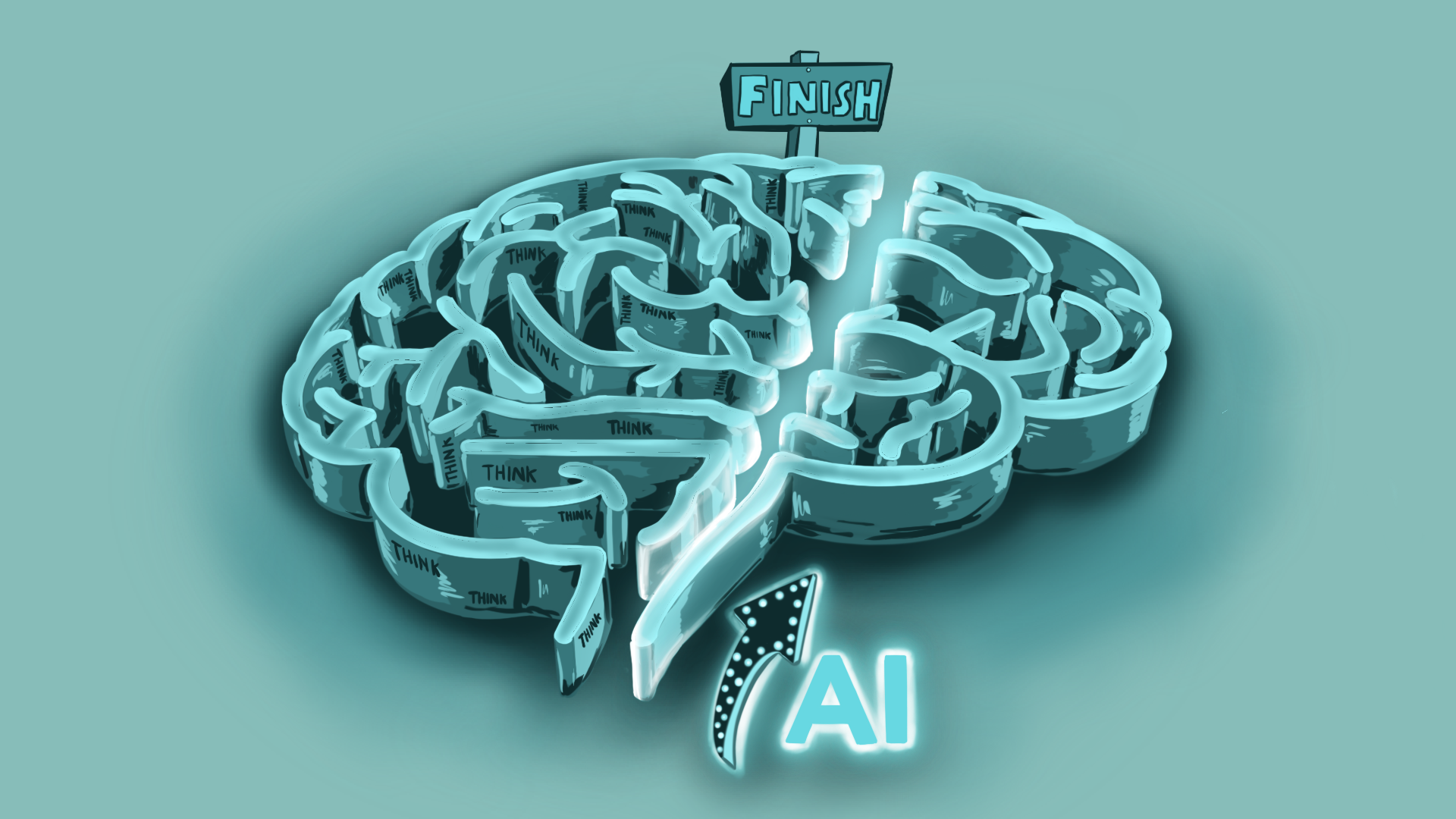
Illustrated by Mara Chintea
GEN AI WROTE THIS TITLE
Generative AI wrote the title of this article. In seconds, it took weeks of research, hundreds of words, carefully curated themes, and compressed them into a three word, punchy headline.
While impressive on the surface, this moment represents something deeper. Every time we ask Artificial Intelligence (AI) to perform a mentally strenuous task, compressing a cumbersome process into a convenient prompt, it saves us effort. But in doing so, each ask works to gently erode what for centuries have been beneficial, essential, and inherently human processes: the processes of thinking, reasoning, and learning.
The growing use of Generative AI in people's academic, professional, and personal lives, is encouraging a broader shift towards a culture of compression: a shorthand way of thinking. Rather than read studies, we skim summaries. Rather than work through reasoning and form opinions, we generate conclusions. Rather than learning and understanding how to perform processes ourselves, we use AI tools to produce outputs. The effect is twofold: efficiency and productivity see huge increases, but at the same time, cognitive friction, the mental effort through which we learn, erodes, taking with it genuine understanding, expertise, and increasingly, original expression.
Think you're safe? Think again.
Universities may appear to be safe harbours from the tumultuous waves AI is making across society. While AI use within schools does continue to expand, there are safeguards: AI cannot sit a person’s exam, for example, nor are students allowed to use AI tools to directly generate work. These boundaries preserve the link between a student's output and performance, and their actual understanding.
It is a startling experience, then, when students leave school, enter the workforce, and the curtain drops. The regulations that once ensured aptitude in critical areas by enforcing a boundary between AI-generated and human-generated work, become far less clear. In the workplace, AI is everywhere. Chat GPT drafts your emails while Copilot builds your spreadsheets. AI is able to analyze data, summarize texts, generate presentations, and assist with tasks that previously required knowledge and practice accumulated over years.
AI is clearly capable of producing competent outputs. The difficult question is what happens when the outputs people produce and present are no longer reflective of their intellect, and cognitive capabilities. As AI becomes embedded into everyday work, the distinction between what a person understands, and what a person creates, becomes increasingly difficult to determine.
This shift goes beyond the workplace. It extends into the world, manifesting itself in a visible change in the relationship between the thoughts people have, the ways they communicate them, and the work they produce. As AI becomes increasingly embedded in thinking and communication norms, a ‘Culture of Compression’ ensues, reshaping cognition, conversation, and ultimately, human intelligence.
Compression of Cognition
Compression of Cognition describes the reduction of complex cognitive processes into AI-generated outputs. Rather than engaging in cognitively demanding processes like reading, reasoning, analysing, forming judgments and producing original work, people begin to rely on AI to generate summaries, answers, and conclusions, in their stead. As a result, the thinking process becomes compressed into a prompt, yet a person is still able to present a high quality output.
Compression of Cognition does not merely describe the deleterious effects of using generative AI as a tool; it describes a broader mindset shift in which sacrificing the cognitive process is increasingly seen as an acceptable cost for efficiency. The problem is that as literature gives way to summaries, reasoning gives way to TL;DRs and learning gives way to outputs, people lose cognitive friction: the mental effort that is involved in reading a complex text, in wrestling with ideas, and in forming independent judgements. The same mental effort which, ultimately, strengthens our minds.
Generative AI accelerates this shift by making it almost effortless to bypass the processes that used to be required for competent performance. Tasks that once required sustained effort and engagement, from brainstorming ideas, to writing essays, to creating an intricate excel sheet with just the right functions, can now be completed in seconds. We are no longer just delegating tasks; increasingly, we are delegating the act of thinking itself, through a process called cognitive offloading.
Cognitive offloading refers to using external resources to complete cognitive tasks. Studies increasingly show, however, that in using AI to offload cognitive effort, people lose opportunities for critical development. Research on the effects of AI-assisted cognitive unloading maps the effects to different faculties of the brain, showing a link to declines in memory, critical thinking, and creative confidence. One study investigated the impact of AI tool usage on critical thinking, considering cognitive offloading as a potential mediating factor. Accounting for a range of independent variables, the study produced the following correlation matrix describing 3 consistent relationships:
Source: AI Tools in Society: Impacts on Cognitive Offloading and the Future of Critical Thinking
The results displayed the following:
Strong positive correlation between AI tool use and cognitive offloading, indicating that higher AI usage is associated with higher degree of cognitive offloading.
Strong negative correlation between AI tool use and critical thinking, indicating that increased use of AI tools is associated with decreased critical thinking skills.
Strong negative correlation between cognitive offloading and critical thinking, indicating that as cognitive offloading increases, critical thinking decreases.
A further mediation analysis indicated that cognitive offloading mediates the relationship between AI tool usage and critical thinking, meaning that cognitive offloading plays a significant part in explaining the link between AI usage and cognitive decline.
These implications are not descriptions of a hypothetical, somewhat dystopian future: they are present and occurring. Each time we choose to generate an answer instead of thinking through a problem ourselves, we give up an opportunity to strengthen our cognitive capabilities for the convenience of an immediate result. The danger is not that this happens one time, but rather that we gradually lose the habit, and eventually the ability, of thinking for ourselves.
A Brookings Institute report on AI in education, which describes the role of generative AI in a growing literacy crisis among students, captures this shift with startling clarity. Quoting an education expert, the report says:
Teenagers used to say, “I don’t like to read.” Now it’s “I can’t read, it’s too long.”
A student interviewed for the report adds:
Personally speaking, it doesn’t make sense for us to read a 50-page book when in five seconds we can research it and ask questions in AI.
This response perfectly encapsulates the Compression of Cognition. The value is no longer found in reading, understanding, and critical thinking, but rather in the endpoint production. We have begun to solely value the product, whilst forgetting that the process is what develops the person capable of producing it.
The Age of AI is here, and it is our responsibility to ensure that in its face, we become more intentional about exercising the cognitive capabilities that enhance our ability to learn, understand, be creative, and think independently.
Compression of Conversation
Compression of Conversation describes the reduction of individual expression into standardized, AI-mediated communication. As people increasingly use generative AI to create, refine and structure their written communications, language becomes more polished, but less reflective of the individual. On a larger scale, language as a whole leans towards increased homogenization.
This shift is present both in natural communication, and on the internet. A study on the use of AI in restaurant marketing revealed that generative AI tools contribute to content homogenization, causing businesses to produce content similar in vocabulary, structure, topic, and style. A separate study on the impact of AI-generated text on the internet revealed that by the middle of 2025, approximately 35% of newly published websites were classified as AI-generated or AI-assisted. The implications of this go beyond concerns of cognitive offloading; the same study found that as AI text becomes more prevalent on the internet, the range of unique ideas and diverse viewpoints that are expressed, shrinks. The internet's tendency to act as an echo chamber that reinforces existing beliefs has long been cautioned, but generative AI adds another layer to that concern. It goes beyond algorithmically reinforcing similar ideas, as it proliferates content that matches in language, structure, and underlying patterns of thought. By doing so, it risks steering online discourse and expression toward uniform styles and ideas.
But it doesn't stop there. Recent research found that reliance on LLMs changed more than the style of a person's writing; it also changed the substance. In creating written work, participants who used AI produced arguments that differed significantly in meaning when compared to those who did not use AI, or used it in a more restrained capacity. AI altered their conclusions, the stances they took, and even the types of arguments they used. Interestingly, LLMs made these changes even when prompted to only make grammatical improvements.
Most strikingly, those who heavily used LLMs simultaneously acknowledged that the generated works reflected a loss of their voices and creativity, while also reporting that they were satisfied with the text they produced.
Could AI, possibly, change your outlook on the world, without you even noticing it?
The effects may soon even be seen on an institutional level. At the 2026 International Conference of Learning Representations, a leading AI conference, the peer reviews that were found to be AI-generated focused on a different set of scientific criteria. While this was an isolated example, it suggests the possibility of a larger-scale problem. If AI begins to shape the standards and language of institutions, academia and social discourse may begin to reflect AI language and judgment patterns rather than diverse, human, ideas and critiques.
AI is affecting more than the way we speak. It is affecting what lies at the very core of human communication: the exchange of original thought and ideas.
Culture of Compression
Language and thought have always been interwoven. Language is the medium through which we express cognition. In turn, articulating our thoughts gives us a chance to receive feedback, refine our thinking, and grow as learners, thinkers, and individuals. Thinking shapes communication, and communication shapes thoughts.
Generative AI affects both ends of this process. It is capable of diminishing our cognitive capabilities, and when invited, can simultaneously hijack the language used to express our thoughts. These two issues, while seemingly independent, may actually reinforce one another. As people offload the thinking process, they also delegate the articulation of the ideas that result. And as the language and ideas we interact with become increasingly homogenized, the opportunity to develop independent thought may be affected.
The use of AI to produce outputs creates another vicious cycle: once AI usage makes outputs easier to produce and work faster to accomplish, that speed and compression becomes the new standard. Employers expect faster work, students expect summaries rather than lengthy texts, individuals increasingly expect answers and endpoint production instantly. And thus, a Culture of Compression emerges, in which summaries replace critical thinking, outputs replace learning, polished communication replaces unique expression, and efficiency becomes nonnegotiable.
You Write the Conclusion
Generative AI is not the first technology to drastically change the way people work, learn and live. Every major technological advancement, from the calculator, to the GPS, to the computer, has in some way reduced the amount of effort people had to exert, making their lives easier. But generative AI is unique in the extent in which it compresses cognitive labor. It does not simply make processes faster; it allows people to bypass them entirely.
And when we bypass the process, we may still arrive at the final output, but the output was never the full extent of the value a process could provide. Reading has never been valuable simply as a means to acquire necessary information. Writing has never been valuable solely for the work it produces. Reasoning has never been valuable because of the answers that follow. Their value lies in the opportunity to expand our minds, learn, grow, and develop.
A culture of compression asks us to achieve efficiency at the cost of our growth. Get it done faster, get it done today, lean on ChatGPT, lean on Copilot, produce now. And often we respond to those expectations. We have been wired to assess competence on the basis of speed and accuracy rather than depth of understanding. If a tool can eliminate the difficulties that stand in the way of that, of course we reach for it. But some forms of difficulty are not inefficiencies to eliminate; they are experiences through which we learn. So, in a world fixated on efficiency, learning can no longer be passive. With generative AI in the passenger seat, we are no longer forced to break down complex passages, wrestle with difficult ideas, or find the right words to express our thoughts. Artificial Intelligence will easily perform those functions. The responsibility, then, shifts to us. We need to make the active choice to engage with processes that develop our minds and allow us to communicate authentically, even when there are shortcuts available.
So learn Artificial Intelligence, learn from Artificial Intelligence. Let it help you, and accelerate your work. But don’t let it replace you, or the processes that you learn from. Read the article, not the summary. Write the draft yourself. Learn the process. The temporary frustration of learning, of taking the extra time and going the extra mile, is a small price to pay for the understanding and expertise it builds.
Your greatest competitive advantage in the age of AI will not be your ability to write prompts. It will be your ability to think without them.