
Canada’s Proposed Alberta-B.C. Pipeline: Ambition or Reality?

Illustrated by Jina Kim
More than a decade after the Northern Gateway pipeline proposal collapsed amid regulatory challenges and political opposition, Alberta is yet again proposing a new pipeline to British Columbia’s coast. The “one million barrels per day” pipeline is set to advance Canada’s energy independence and strengthen its position in the global energy economy. By diversifying beyond the United States as its primary export market and providing greater access to international buyers like those in Asia, Alberta argues this project would promote Canada’s economic resilience. Still, before construction has even begun, Alberta is already facing the same challenges that have lingered from previous projects.
Alberta is set to spearhead a new West Coast oil pipeline plan that could strengthen Canada’s exports and bolster its energy sector. The proposal arrived at the Federal Major Projects Office on July 2nd, 2026, setting a goal of shipping “one million barrels per day” of oilsands crude to British Columbia’s coastline and beginning construction by September 2027. However, the success of this project will depend on overcoming similar barriers that have undermined previous pipeline proposals. Looking at past pipeline failures demonstrates how financial uncertainty, Indigenous consultation, and environmental concerns ultimately determine whether the West Coast pipeline becomes a reality.
Beyond the United States Market
Canada exports a vast majority of its crude oil to the United States, with Alberta being the largest producer. However, recent tensions in Canada–United States relations, including ongoing tariff threats and President Trump’s repeated suggestions of Canada as a “51st state,” have renewed concerns about the risks of relying on a single trading partner. In response, Prime Minister Mark Carney and Alberta’s Premier Danielle Smith have adamantly championed the West Coast pipeline project as a means of encouraging energy sovereignty and connecting export routes to Asian countries to create new partnerships. In doing so, the project would allow Canadian producers to diversify their oil exports, improve their long-term economic resilience, and advance Carney’s vision of Canada as an energy superpower.
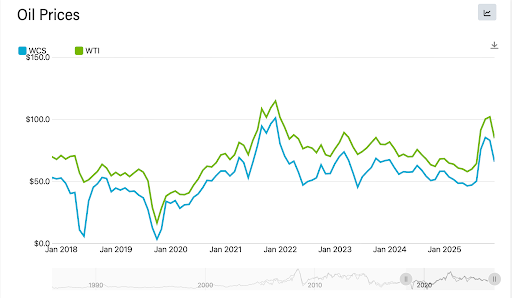
Beyond export diversification, this pipeline would help address the challenge facing Alberta’s oil industry: the Western Canadian Select (WCS) price discount. Alberta’s oilsands are landlocked, forcing Canadian producers to transport crude long distances before accessing international waters. As a result, WCS trades below the North American benchmark, West Texas Intermediate (WTI), to reflect the transportation costs and the heavier crude. Alberta’s proposal to expand the pipeline to the Pacific would reduce transportation hurdles, ultimately narrowing the WCS-WTI price differential and allowing producers to realise true oil sands market value. By improving the competitiveness of Canadian oil, this project could increase producer revenues and bolster economic benefits across Canada’s energy sector.
Need a Job?
Supporters contend that strengthening Canada’s energy sector is vital for economic growth. By increasing export capacity, the pipeline could generate billions of dollars in economic activity through construction, operations, and increased revenues. Employment is another central argument. Canada’s oil and gas industry currently employs approximately 192,500 workers, a figure projected to grow over the next decade. In addition, every $1 billion CAD invested in energy infrastructure is estimated to create roughly 5,400 jobs, ranging from engineering to skilled trades. Proponents argue that projects of this scale would not only help address anticipated labour shortages, but ultimately sustain long-term employment.
Under the proposed timeline, the pipeline is expected to be operational between 2032 and 2034. Alberta estimates the project will cost up to $43.7 billion CAD and has committed funding to the initial planning stages while continuing consultations with Indigenous communities and industry partners. However, despite the economic promises outlined by supporters, questions remain over whether the project could truly overcome the environmental, Indigenous, and financial challenges that have historically plagued similar pipeline projects.
Why are Pipelines so Controversial?
Despite the outlined benefits of expanding Canada’s pipeline network, major energy infrastructure projects have faced significant financial, environmental, and social barriers. Pipelines represent the crossroads of governments, investors, Indigenous communities and environmental organizations, making seamless agreement impossible. This process is described as contested assetization, wherein pipeline developers use financial arrangements and market valuation to transform a proposal into an investable asset. Unlike traditional assets, however, a pipeline is built on the assumption of future economic returns. Investors believe that oil demand will remain strong and that regulatory conditions will generate long-term profitability.
These expectations make pipelines inherently contested, as the same tools used by pipeline supporters provide opportunities for opponents to create friction through legal challenges and divestment campaigns. In Canada, pipeline timelines remain challenged by environmental groups who worry about ecological risks associated with oil drilling, as well as Indigenous and local communities along the pipeline route.
Alberta’s proposed West Coast pipeline reflects this dynamic, with proponents justifying the project through expectations of economic returns, including increased exports and broader GDP growth, while opponents question if the outlined benefits outweigh the costs.
The Northern Gateway Pipeline Failure
Canada’s previous pipeline projects demonstrate these difficulties. The Northern Gateway pipeline, proposed by Enbridge in 2004, closely resembles Alberta’s current proposal. The project was designed to transport oilsands crude from Alberta to the coast of British Columbia, where it would be exported to Asian markets. Although it received federal approval in 2014, it faced massive opposition on various levels that eventually led to its failure. Many Indigenous groups and local non-governmental organizations opposed the route due to ecological concerns and impacts of potential oil spills. These concerns were compounded by financial uncertainty, as estimated costs increased from approximately $2.5 billion CAD in 2005 to nearly $8 billion CAD in 2013. Following extensive legal battles and a struggle to secure a shipping agreement, in 2016, the federal court rejected the project.
More than Economics: Environment at Play
Financial challenges represent only one part of the broader pipeline debate. Environmental concerns remain a central source of opposition. The David Suzuki Foundation contends that the project sends a conflicting message about Canada’s climate priorities, suggesting that continued investment in new fossil fuel infrastructure is inconsistent with efforts to achieve lower emissions. Simon Donner and Catherine Abreu, former members of Canada’s Net Zero Advisory Board, have similarly questioned whether expanding pipeline infrastructure is compatible with Canada’s commitment to achieve net-zero emissions by 2050. They maintain that the project is built on dishonesty and that its construction will hinder Canada’s climate targets.
Beyond emissions concerns, local communities opposing the pipeline highlight the potential consequences and aftermath of oil spills. In 2010, Enbridge faced backlash due to its oil spill in Michigan, one of the costliest inland oil spills in the United States’ history. For communities along British Columbia’s coast, these past incidents have left people wondering whether emergency response systems in Canada would be sufficient to address major spills in marine environments.
These concerns have been particularly significant among Indigenous communities, many of whom argue that the pipeline debate extends to questions of land ownership and conservation. Marilyn Slett, President of the Coastal First Nations’ Great Bear Initiatives, an alliance of nine First Nations communities, has rejected the proposal, citing concerns over habitat destruction, risks to human health, and threats to local ecosystems. Other coastal First Nations leaders have criticised the project, threatening to use legal tools to delay the project’s construction, claiming that decisions affecting territories and marine environments require participation from affected communities. For First Nations in British Columbia, the rich coastal waters represent more than an ecological resource; it is connected to cultural identity and contributes to their economic livelihoods. The waters have sustained their fisheries and traditional practices, and oil tankers could threaten these ocean-oriented systems.
Opposition has further emerged from British Columbia’s provincial government. Premier David Eby has criticised Alberta’s approach, arguing that the province was blindsided by the planning process. His opposition reflects broader tensions over jurisdiction, as Alberta frames the pipeline project as advancing Canada’s economy, while British Columbia emphasises a responsibility to protect ecosystems and affected communities.
Why This Matters
The outcome of Alberta’s pipeline proposal extends beyond the energy sector. If constructed, the pipeline could alleviate pressures facing Canada’s resource economy, as limited pipeline capacity has constrained export opportunities. TD Economics highlights the pipeline’s projected macroeconomic benefits to Canada’s economy, namely expanding exports, improving market access, and higher GDP growth. For Canadians, this project could translate into direct economic benefits through increased employment opportunities in energy-related industries, which supports household incomes and local economies. Through resource taxes and royalties, this project could increase government revenues that support fiscal capacity for public investments, further strengthening’s Canada’s economy and energy independence.
What’s Next for Alberta and British Columbia?
The future of the pipeline remains to be seen. Before construction can begin, the proposal must undergo strict regulatory review, which will be done in tandem with Indigenous consultation. One of the most immediate challenges is determining the pipeline’s route, and which corridor would bring the most advantageous outcome for the provinces. The proposal will also test the relationship between Alberta, British Columbia, and Indigenous communities. How the Albertan and Canadian governments will navigate these challenges will likely determine whether this project will truly be different from previous pipelines. Ultimately, Alberta’s proposed West Coast pipeline is far larger than the debate over energy infrastructure. It represents a broader question about Canada’s economic future: how to strengthen energy independence and strengthen markets while balancing environmental, Indigenous, and regional voices.