
Music, Running Water, and Electricity; The Implications of the Modern Music Economy
In his June 2002 interview with The New York Times, David Bowie famously stated, “Music is going to become like running water or electricity.” At first, I didn’t understand what he meant by this prediction. However, after researching revenue distribution, recent changes in listening patterns, and new data algorithms implemented by tech companies, I realized he might be exactly right. Of course, music is not as crucial to our survival as running water or electricity, but has the way we perceive music shifted from an art form to a public utility?
Like many students, most of my day, I am listening to music. While walking to class, my airpods are in, while cleaning my room my speaker is blaring, and even while studying, music hums in the background; I didn’t realize how much music, sometimes passively, underlies my daily life. Growing up with Spotify, I felt lucky to have access to all genres, at all times. Other than the occasional decorative record for my room, I knew nothing other than Spotify’s streaming format and algorithmic consumption styles. It is now the easiest it has ever been to produce and release music, and that’s without considering AI developments. I learned that 30,000 fully AI generated tracks are uploaded daily on streaming services like Deezer. Nowadays, artists can put their music out with the click of a few buttons; wouldn’t you think generating revenue is easier than ever? That’s where I was wrong.
According to Hua Hsu from The New Yorker, “If you think too deeply about what you’re paying for, and who benefits, the streaming economy can seem awfully crooked.” In this article I hope to explore how the digital era of music has impacted revenue distribution in the music economy, from artists themselves to the massive enterprises receiving monopoly allegations.
The Streaming Payout Problem
Over coffee with a Berklee graduate and childhood friend, Alex Hoskyns, I asked her how much she gets each time someone streams her music. I’d assumed that with such high-quality production, she’d earn at least a cent per listen. Instead, Spotify pays artists about 0.0001 cents per stream. That means one million plays earns roughly one dollar. This left me wondering: what does today’s streaming-driven music economy mean for artists, and how do they make a living if they aren’t Taylor Swift?
Spotify Syndrome
Spotify, however, is doing incredibly well financially. Their CEO, Daniel Ek, is richer than any musician in history, having cashed out approximately $340 million in company stock since Summer 2023. Their company is worth more than Universal and Warner combined, which have been around much longer. Spotify has become a master of hyper-personalization and convenience, something in high demand in our economy. In terms of their artists, however, a newly instituted policy states a track that registers fewer than a thousand streams in a twelve-month span earns no royalties at all. This means 60 million songs, 2/3s of their catalogue, earn no royalties. Decades ago, at this stage, early artists might have earned some revenue from selling records or CDs, and many Generation X’s experienced that initial transition. Spotify has also been successful at certain cost-cutting measures, cutting fifteen hundred jobs in December, 2023, furthering their share of the music economy.
The Artist’s Slice of the Pie
A 2024 study in the UK, The Artist’s Share of the Music Streaming Pie, examines how the streaming economy has impacted artists. For example, a label selling a CD for $15 USD would need to sell about 133,000 copies to generate around $2 million in revenue, the equivalent of a gold certificate in the US. Considering typical deductions, in the worst case, the musician would hypothetically receive a net share of 5 per cent of the revenue, still resulting in an income of US $100,000. This comparison highlights how physical sales once gave artists a clearer, more substantial cut, whereas streaming multiplies the effort required to reach the same income.
Yet, the transition to the streaming economy drops the profit margin for the label to 12 per cent, around 1.7 million downloads would be needed to generate a total revenue of US $2 million, meaning 3.4 times more album downloads than CD sales would be needed to generate the same revenue. This shift shows how streaming transferred bargaining power away from artists and toward platforms, making it much harder for musicians to reach the same financial benchmarks they once could with physical sales.
Figure 1: Monthly music streaming revenues for 1 million streams in the UK (in GBP) by stakeholder
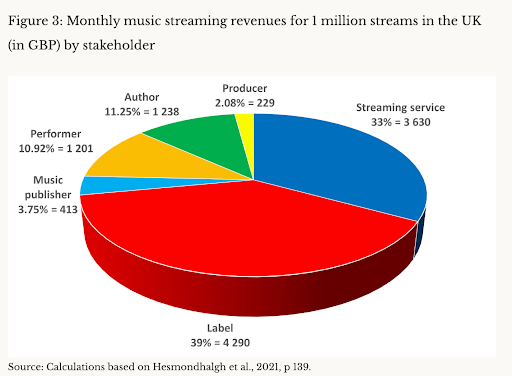
The pie chart makes clear that the largest portions of streaming revenue go to the label and the platform itself, leaving creators with noticeably smaller slices of the pie.
Figure 2: The distribution of music streaming revenue in the UK
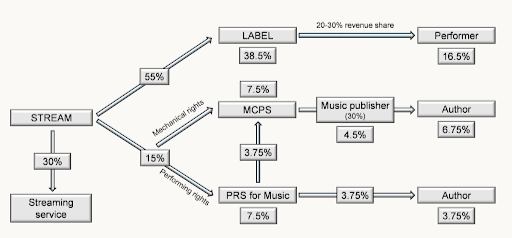
Source: After Colin Young, 2021, Comparison of Streaming Treatment by Record Label and Publishing Company, Report for the DCMS Committee Hearings on the Economics of Music Streaming, February-March 2021.
According to Figure 2, there is a clear description of the tiny slices for creators. Music publishers capture 4.5% of the streaming pie, while authors (composers/lyricists) receive 10.5%. In favorable contract terms, a singer-songwriter is more independent and writes, performs, and composes their own songs, they could claim up to 27% per cent of streaming revenue, but that still leaves a good 73% diverted elsewhere. The flow diagram underscores how fragmented payments are, with each intermediary taking a portion before the artist sees their share.
Figure 3: Number of artists per streaming and income threshold, UK 2014 and 2020
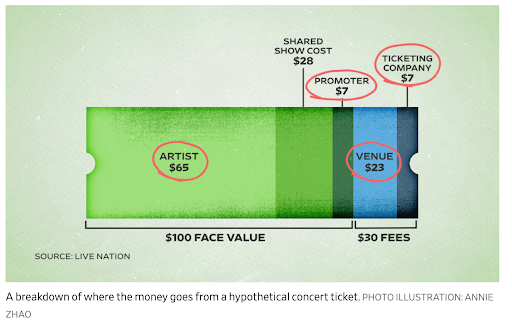
Figure 3, compares 2014 and 2020, showing a clear improvement in the income situation for musicians. For example, in 2014, Taylor Swift had her music removed from Spotify, only 187 musicians were able to cross the threshold of 1 million streams per month. However, by 2020 the number increased to 1,613, but in the UK the median income of full-time employees according to the Office for National Statistics (ONS), is 31,000, where 72 per cent of survey respondents earned no more than GBP 30,000 per year and were therefore below median income. The data suggests that while more artists are breaking into the million-stream bracket, the vast majority still earn incomes well below national averages, showing that growth in streaming doesn’t automatically translate into sustainable earnings.
Hearing the Artists
While industry data shows how little of the streaming pie goes to musicians, I wanted to hear directly from artists regarding how these numbers translate into their daily reality. I interviewed two Berklee students for their first-hand opinions on changes in the music industry and how musicians earn revenue. One noted a few positives: “For smaller artists, playlisting can be a really good tool to get your music out there,” explaining how songs can be submitted to playlists before release. Getting onto bigger Spotify editorial playlists, however, can be difficult, especially if the algorithm favors more popular artists or AI bands. Presaving songs can help push the algorithm toward better placement and support. For live shows, they described high costs and low returns: venues often take a percentage of ticket sales, and in pay-to-play situations, artists may walk away with only a few dollars—far from covering expenses.
Monopolistic Control: Live Nation and Ticketmaster
Although streaming is incredibly popular, many artists still generate major revenues from live music and events itself. There is a growing argument that we are witnessing a form of monopoly or oligopoly in the music industry, specifically in these areas of streaming and live events. While by definition, there is not a complete monopoly, there are a few powerful entities with major control, potentially impacting artists and potentially limiting competition. In 2010, Live Nation, a global leader in concert promotion, merged with Ticketmaster, a leader in concert ticket management. According to a 2023 CNBC report, Ticketmaster controls roughly 70–80% of ticket sales for major U.S. venues, a dominance that has fueled concerns about dynamic pricing and hidden fees. Bruce Springsteen famously stated in 2009 that the merger deal was likely to “return us to a near-monopoly situation in music ticketing.” Although the U.S. Department of Justice scrutinized the Live Nation x Ticket Master merger, post-approval there has been a lot of pressure on Congress to modernize and strengthen outdated federal antitrust laws, calling it an illegal monopoly.
According to Live Nation’s 2024 financial reports, the company generated $23 billion in revenue by maintaining a presence in every corner of the industry — a model known as vertical integration. Previously, artists would go on tour to promote album sales, but now you put out music so you can go on tour and sell tickets and merchandise, as streaming is not a viable way of making money.
Imaginary Concert Ticket
A hypothetical concert ticket represents the distribution of our consumer spending, and to whom. In this $130 ticket, $65 goes to the artist, $28 is a shared show cost, $7 is for the promoter, $23 for the venue, and $7 for the ticketing company. Live Nation’s 2024 annual report shows ticketing revenue reached $2.9 billion. As the world's largest global concert promoter, this exercise can help us understand that even when an artist is playing shows, they still only get 50% of the total ticket cost.
What the Music Industry Reveals About All Industries
Music has never been more accessible; however, this raises the question: are we satisfied with how the industry has evolved, with only bigger artists selling out shows as the ones able to sustain themselves? When a subscription to an audio streaming service costs much less than a single album once did, where does the utility lie? Consumers may benefit in the short term from lower costs and wider choice, but over time may be fed music that fails to contrast or challenge their tastes. Should music always be comfortable? Some may argue there is a moral imperative for institutions to limit these algorithms, but if so, shouldn’t that apply to all industries? Whether we will eventually tire of algorithmic convenience remains unknown.
Tech firms care about our time and attention. Unlike a record label, a tech company couldn’t care less if we are lost in a three-hour ambient loop, as long as our AirPods are in and we listen passively. At that point, does it matter who is making the music? Cost-free AI-generated music is becoming increasingly popular. It has never been easier to put art into the world, but only if you have no aspiration to make money from it. These same shifts are appearing across platforms like Instagram, Snapchat, and the ~90 per cent of other applications now incorporating AI.
In 2024, my Spotify Wrapped reported I listened to 63,299 minutes of music. I once saw this as supporting my favorite artists; now it feels more like a testament to Spotify’s algorithmic skill and tactful use of artificial intelligence. Digitalization is reshaping every industry, making it more important than ever to understand who benefits. Perhaps a constant stream of familiarity is preventing us from finding what we truly would love. There seems to be a lot more noise in the world than previously. At this point, Spotify’s only competitor seems to be silence.