
FTC v. Meta AntiTrust Trial: Why the Courts Got it Wrong
Facebook’s inception is nothing short of spectacular. What began as a college networking website out of Mark Zuckerberg’s Harvard dorm room in 2004, Facebook has ballooned into the largest social media platform in the world. Facebook’s influence is difficult to conceptualize: a USD $1.2 trillion valuation, a collective reach of 3.4 billion active users in 2025 - more than the populations of China, India, and the USA combined, generating over USD $103 billion in annual advertising revenue. Meta Platforms, the parent company of Facebook, now owns Instagram, WhatsApp, and Messenger among others. Meta commands an influence that very few companies in the world have had; with their platforms influencing how we communicate, information we share, and the user algorithm we are exposed to.
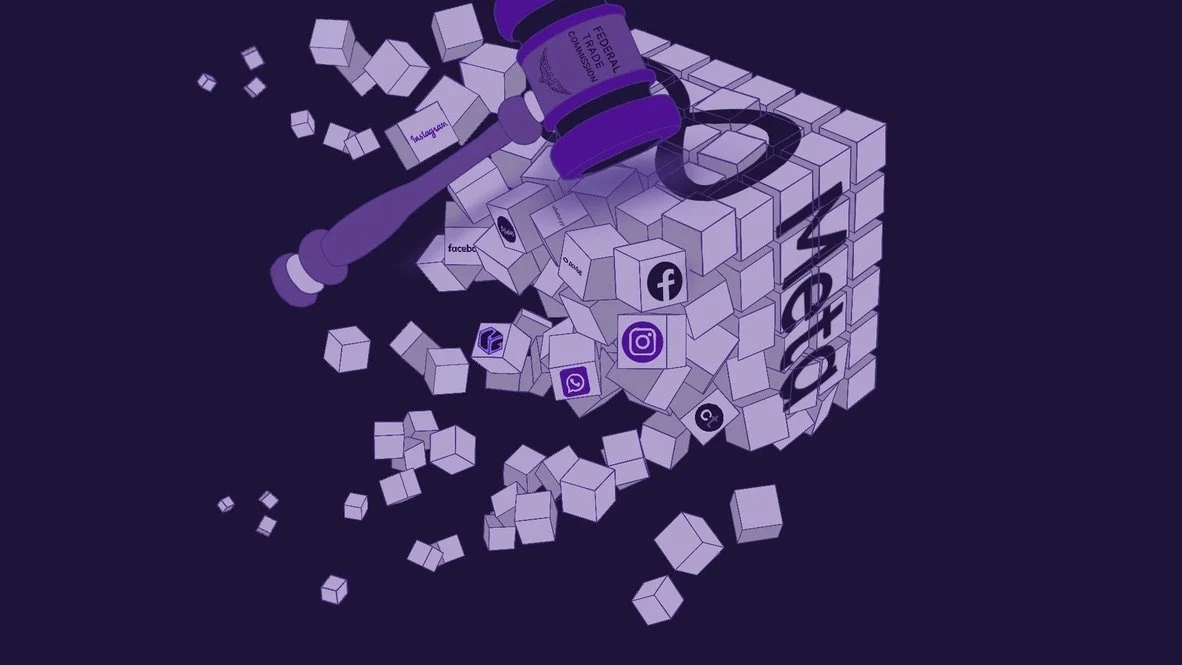
However, Meta’s size and sweeping influence and size raises concerns. In FTC v. Meta, the Federal Trade Commission (FTC), the U.S. government department responsible for promoting market competition and preventing monopolistic activity, is tasked with proving that Meta bought their way into market dominance, rather than earning it through innovation. The FTC argues that Meta illegally maintained a monopoly by purchasing competitors Instagram in 2012 and WhatsApp in 2014, absorbing the competition before they could challenge Facebook’s dominance. The FTC maintained that apps such as X, Youtube, and TikTok are all ‘broadcast’ based apps, and that the only true ‘friend to friend’ social media competitor is Snapchat, a company Meta has already tried to acquire.
The verdict for the trial, which began on April 14th, 2025, and wrapped up in the months following, concluded with the decision on November 18th - with the Federal District Court of D.C ruling in Meta’s favour, rejecting the FTC’s argument for a platform breakup. Judge James Boasberg stated that Meta’s dominance in personal social networking does not warrant a breakup, hence allowing Meta to continue their operations without divestiture or regulation. A ruling in favour of the FTC would have signaled that the United States still believes in the principles of fair market competition that built its economy. But the actual ruling instead shows how difficult it is for antitrust laws to address monopolies where harm is not measured in price.
The Case for FTC: Pre-Emptive Acquisition
To understand what is at the heart of FTC’s case first requires understanding the idea of the ‘pre-emptive acquisition.’ In the early 2010s, Facebook became increasingly concerned with losing younger users to Instagram’s visual and photo-sharing design, as well as WhatsApp’s encrypted ad-free messaging service that had risen to prominence around the world. Internal emails made public during the investigation show Zuckerberg warning that Instagram could “steal time from Facebook users…could meaningfully hurt us if left independent”, to acquire WhatApp before they became a threat. Merely two years later, Facebook bought Instagram for USD $1 billion, and WhatsApp followed in 2014 through a USD $19 billion acquisition. Facebook didn’t purchase WhatsApp because they needed a messaging app, it was because WhatsApp offered a new approach for users frustrated with Facebook’s data collection, with data-privacy and encryption, as well as an ad-free interface, WhatsApp could have forced Facebook to compete on privacy, design and data transparency; instead, they have been absorbed by the same advertising ecosystem; adding advertisements to WhatsApp’s user interface.
As a result, this gives users little options for change, giving users the same monotonous experience with little innovation. In what could have been a marketplace where several companies compete on innovation and privacy, a single company now controls the ads they see and privacy settings we are allowed to use. By definition, this is exactly what the FTC defines as an anti-competitive product, as Facebook used acquisitions to prevent future competitors from emerging, acquiring any type of innovation before it matures. This creates what VCs call a ‘kill zone’ to competition, start-ups know that Meta will likely copy or outprice any new innovation they create. According to the Venture Capital Journal, big tech acquisitions have reduced early stated funding in social media ventures by nearly 40 per cent since 2015, following the WhatsApp acquisition. Such a reduction in venture capital funding chokes out the industry, as start-ups face larger obstacles to develop their product.
Without any meaningful pressure to innovate their product, Meta can copy features from smaller apps, dictate ad pricing, and collect excessive amounts of personal data on their consumers, without fear of losing market share.
How Consumers Pay the Price
Although a free product, consumers pay in more ways than one. Loss of data privacy, attention exploitation, and diminished choice in other platforms that offer better user experience. This trade-off exposes the true cost of Meta’s dominance, when a single company owns the marketplace, users have no other meaningful alternative.
What is equally troubling is Meta’s track record on user privacy and data-control, demonstrating the dangers of their monopoly. Within this track record are several instances, such as the Cambridge Analytica scandal in 2018, when it was revealed that Facebook allowed third parties and consulting firms to access the data of up to 87 million users without their consent. These companies then used these data points for targeted political advertisements and user profiling. Beyond Cambridge Analytica, Meta has recently paid a USD $1.4 billion settlement to the State of Texas for automatically scanning photos to collect user’s facial geometric data and facial recognition for commercial use. The lawsuit alleges that Meta continued these practices for ‘more than a decade’ resulting in billions of facial captures without any informed consent. These are not just isolated incidents, but symptoms of an issue at institutional level, where a monopoly’s dominance is able to exploit user privacy and smother any privacy innovation that may threaten their control.
A report conducted by investigative journalism nonprofit ProPublica states that Meta creates the “illusion of choice” as users can change settings to opt out of ‘personalized ads’, but still collects vast amounts of location, behavioural, and engagement data in the background. This undermines any notion of informed consent, as users assume that their data is being protected, when in reality the platform has harvested data they never knowingly agreed to share. If WhatsApp and Instagram had remained a separate company, they might have prioritized user privacy and minimal advertising as a business model, putting pressure on the industry to adopt higher privacy standards. Whereas the result of Meta’s acquisition is a platform more concerned with data collection, than user protection. Considering all of the issues above, a competitive market would punish a company, however Meta’s lack of rivals means there is no effective check on this behaviour.
Why Antitrust Action is Essential for a Healthy Capitalism
Critics of the FTC’s case against Meta would claim that forcing a breakup of Instagram or Whatsapp would be punishing success and capitalism as a whole. However, breaking up Meta would create an environment that capitalism thrives on: bringing back competition to spur innovation and consumer choice. Moreover, history supports the FTC’s case. Antitrust legislation was introduced in 1890 through the Sherman Act, and was first used 21 years later to break up Standard Oil, a company owned by John Rockerfeller, who controlled about 90 per cent of American oil production through aggressive acquisitions. Standard Oil was broken up into 34 independent companies, such as Exxon, Chevron, and BP, resulting in lowered pricing for consumers and new innovations in refining technology. Other examples include AT&T, a telecom company that held 85 per cent of the market, being spun off into seven different telecom companies in 1982. This brought innovation back to the market, with companies like Verizon and T-Mobile experimenting with internet technologies, and driving down long-distance rates, resulting in the U.S. to become a global leader in telecom. According to research done by Columbia University, the cost of a digital line dropped from USD $325 before the breakup, to under USD $100 in 1991.
The examples of Standard Oil and AT&T are one of many cases that prove a consistent pattern: that antitrust action prevents dominant firms from controlling an entire industry, hurting competitors and consumers alike. In both cases, it proved that competition, not consolidation, opened the door to new entrants, new technologies, and ultimately created lower prices for consumers. These examples confirm that restoring competition to the social media industry would bring back innovation, choice and consumer benefits, rather than concentrated growth for a singular platform.
The Court’s Ruling
Although the FTC presents a strong case, Judge Boasberg cited that the FTC did not sufficiently prove that Meta harmed the consumer. As unlike Standard Oil and AT&T, where price-fixing was a clear harm to the consumer, Meta’s services are free of cost. Therefore, the FTC had a difficult task of proving that Meta’s violation of privacy, collection of data, and lack of competition warrant a similar treatment to other violations of the Sherman Act.
As well, Meta’s political lobbying has further disrupted the FTC’s case. In 2025, Meta has spent over USD $13.7M on political lobbying, representing the largest lobbyist group in the technology industry. After Donald Trump was elected President in November 2024, Meta has increasingly tried to gain favour, donating USD $1 million to Trump’s Inauguration fund, and even contributing money to Trump’s new White House Ballroom renovation. In response to President Trump’s criticism, Meta has axed their DEI hiring initiatives, removed content fact-checking, as well as agreeing to pay Trump USD $25 million over his suspension from their platform in 2021. Through this, Meta is hoping to secure preferential treatment and goodwill from Trump, creating a dangerous dynamic where a company under investigation can bribe their way to a more favourable result. By gaining favour with Trump, Meta was able to protect their monopoly not through innovation, rather using political gifts, effectively buying their dominance.
Why This Verdict Matters
The verdict of FTC v. Meta fell short of addressing the broader dangers poised from Meta’s industry dominance. Rather than serving as a landmark case that would shape the competitive landscape in America, the ruling left a single company with control over the social media industry. By breaking up Meta, it could have brought a new era of much-needed competition and disruption to the industry through start-ups, shifting from a corporate monopoly to open competition, unfortunately the court’s decision preserves that status quo.