
The Cry From Within: Women Reshaping Iran
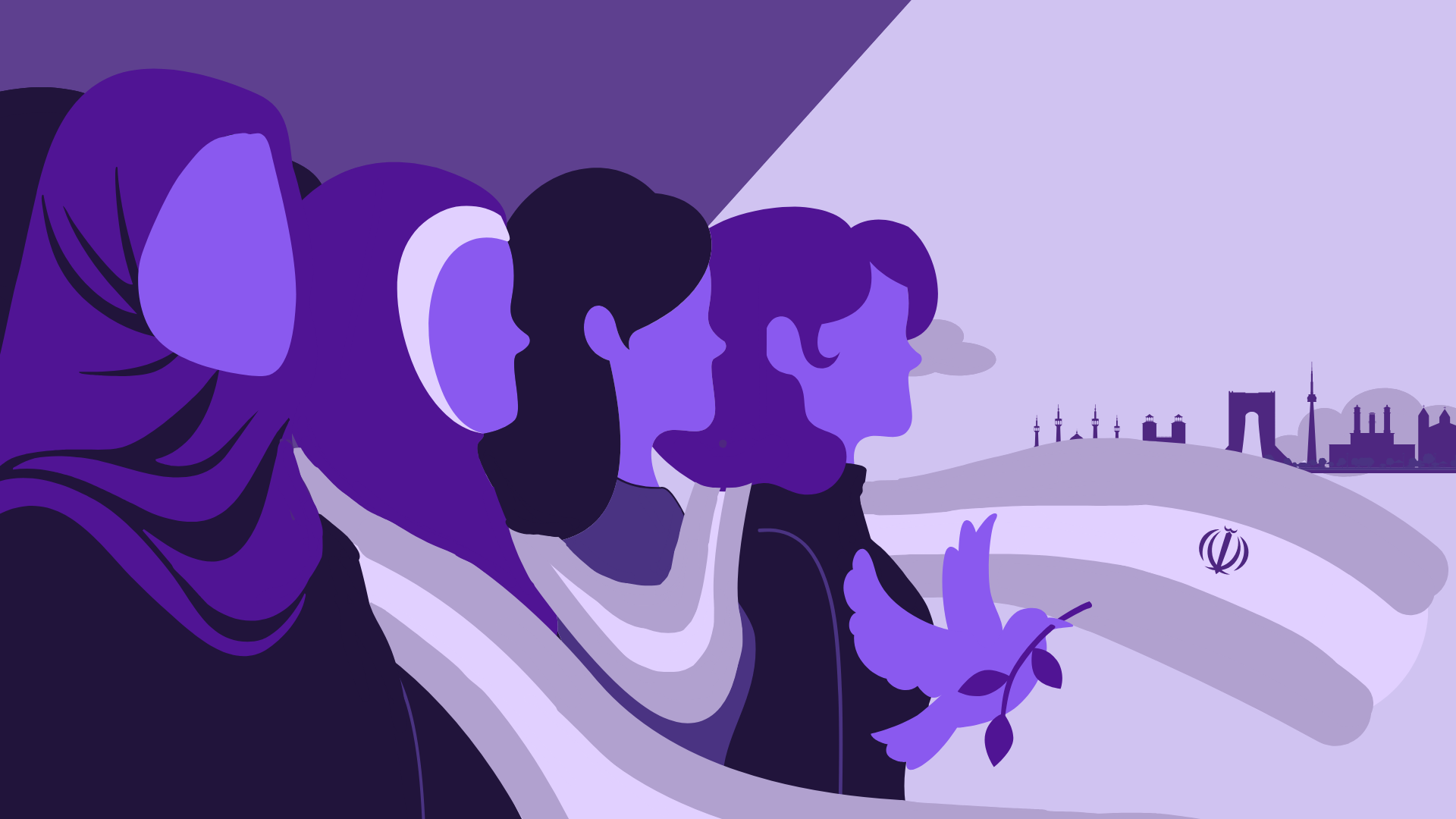
As Anthony Bourdain, the world-renowned American chef and author, once said, "The Iran you see from the inside, once you walk the streets of Tehran, once you meet Iranians, is a very different place than the Iran you know from the news. Nowhere else I’ve been has the disconnect been so extreme."
For decades now, the Islamic Republic of Iran has assumed absolute power over the people of Iran through widespread oppression, systemic corruption, and economic and cultural isolation. The effects have spread both within Iran’s borders, and across the region through its support for proxy conflicts. At the same time, the world has watched Iranian women, in particular, bear the brunt of this regime’s control, having been beaten, oppressed, and silenced. The 2022 death of Mahsa Amini, a 22-year old woman arrested and later killed by the morality police for improperly wearing her hijab, became a symbol of nearly half a century of gender-based repression and a mobilizing call for widespread change
Perhaps the greatest weapon against authoritarian regimes, like Iran, does not wear a uniform nor holds a weapon. Rather, she is a student, a mother, a factory worker, a teacher, fighting not with force, but with defiance. It is not with the backing of foreign powers or military alliances, but in spite of their absence. These are not revolutions forged in the strategy room. Instead, they are born in living rooms, classrooms, prison cells, and protest lines, and perhaps that is exactly what makes them so dangerous. Time and time again, the Islamic Republic of Iran has responded not just with repression, but with fear, because a woman who organizes, educates, and refuses to be silent threatens more than policy; she threatens the very foundation of patriarchal control that has been entrenched for 46 years. If the stories of Iranian women are worth anything, it is that despite being excluded from negotiations and headlines they have not only endured, but challenged the foundation of authoritarian leaders.
Rise and Fall of Reza Shah Pahlavi: An Era of Gender Reforms
The Pahlavi Dynasty, Iran’s last ruling monarchy, held power for 54 years and, during the latter half of its reign, ruled by Reza ShahPahlavi, implemented numerous progressive reforms for women. By 1944, women's education became compulsory, government grants were created for women seeking to study abroad, and federal organisations were formed on behalf of providing women equal opportunity. Fast forward to 1963, and the Shah, much to the anger of Iranian clerics, launched the reform program known as the "White Revolution," a six point agenda which included many progressive changes, one of which being women's right to vote, hold positions in Majlis (Parliament), and serve in the police force. Educational institutes grew to five times the amount that were available in 1941, and access to health services grew exponentially.
To many people today, it is hard to see where the Shah went wrong, but it's important to not look at his reign through rose coloured glasses. Throughout his 38 years of power, the Shah could never seem to escape the growing unrest. The issues with his initiatives ran the gamut from land reforms that were widely unpopular to a complete ban of Islamic veils and changes towards women suffrage laws that became widely condemned by Islamic clerics. Many Iranians saw this as an attempt to "Westernize" Iran culturally, a nation where Islam has been deeply rooted for centuries, and secularizing the nation stripped away that identity.
When opposition to his leadership grew, he doubled-down by suppressing oppositional groups, appointed his confidants, and turned to the United States to prevent a coup d'etat, in a drive towards protecting his power. And while the Shah may have preserved his throne, his dependency on the U.S. came with the cost of losing his political legitimacy. From that point forward, the Shah's task became: balance the needs of Iran versus the demands of the U.S. The Shah had lost the trust of the Iranian people, and despite his best efforts, it was only a matter of time until the pressure was too much.
The Revolution and Introduction of Repressive Women's Rights
It's 1979 and Mohammad Reza Pahlavi, who had ruled as King of Iran since 1941, was forced to flee amid growing civil unrest. In his absence, Islamic cleric Ruhollah Khomeini, a long-time critic of the Pahlavi dynasty, rose to power as the face of the opposition, bolstered by widespread anti-Western sentiment and disillusionment with the Shah’s regime. Following the revolution, Khomeini assumed the role of Supreme Leader and redefined Iran as an Islamic Republic governed by Sharia law. His changes to the regime were radical and stemmed from vengeance: former affiliates of the Shah were executed, political dissidents were imprisoned or killed, and the country's social fabric was rapidly reshaped. Women, in particular, faced immediate and severe regression. Mandatory hijab laws were enacted, their representation in Parliament dropped to just five per cent, and basic freedoms, such as the right to work, travel, or file for divorce were made conditional on their husbands approval.
These reforms set a precedent for how the women of Iran were viewed, and would continue to be viewed from the Islamic Republic. If there was one certainty for the next 46 years, it would be the unwavering effort to silence and remove women from roles of power.
Women, Life, Freedom Movement
Beginning in 1979, after the Iranian Revolution, Iranian women became required by law to wear hijabs, chadors, and loose fitting clothing as part of the country's dress code. A hot topic for decades, that came to a head when in 2022, a 22-year old Kurdish woman, Mahsa Amini, was killed while in custody of Iran's Morality Police, due to violating hijab rules. Witnesses reported that Mahsa and her brother were coming off of the metro when they were confronted, harassed, and then beaten on the street until they were eventually arrested and put into a van. By the time Mahsa reached the detention center, she had suffered severe head trauma from hard blows to the head, resulting in a coma that would ultimately lead to her death days later. Her death was not just a tragedy, but a visceral reminder of the cruelty and unchecked power of the regime’s morality enforcers — that the lives of women could be destroyed over something as simple as a lock of hair. What happened next was unprecedented: a month of protests, with women across the political spectrum standing together. They challenged the Iranian government not only on years of systemic oppression and control over women’s bodies, but also on the broader dissatisfaction with a regime that thrives on fear and silence.
The chant — "Zan, Zendegi, Azadi," which translates to Women, Life, Freedom — became the rallying cry of the protests following Mahsa Amini’s death. Originally used by Kurdish women activists in the early 2000s, the phrase symbolized resistance against patriarchal and political oppression. In Iran, it was adopted and re-energized by protesters — it captures the plight of all oppressed and marginalized bodies, it was a demand for freedom, it was for anyone who felt silenced. There was this irony — the fact that the Islamic regime had poured so much money, time, and resources into controlling Iranian women, and despite that, it was women who became the visible face of dissent, organizing, leading, and symbolizing a broader demand for freedom.
What started out as a strong movement became stagnant. The Iranian government inevitably cracked down and responded disproportionately with violence. From what has been documented, at least 300 people were killed, many shot in protests, some beaten to death, and others executed. The UN reported that many were subject to mock execution, a form of psychological warfare. The 14,000 who were deemed lucky enough, were only ever arrested and received arbitrary sentences without due process.
Although the Iranian regime remains in power, the impact of these movements is undeniable. Today, many women engage in everyday acts of defiance — some choose to forgo the hijab entirely, while others embrace vibrant clothing and use fashion as a form of self-expression — some subtly pushing back against imposed gender norms. In the West where these rights have long been in place, these small acts may not seem like much. But to the Iranian women, it is a symbol of how far they have come… and how far they can still go.
Why Authoritarian Powers Fear Women the Most
While the 20th century marked significant progress toward gender equality, the past few years have told a different story. From Iran's Ayatollahs to the rollback on reproduction rights in Trump's “new” America, we are seeing a regression in women's rights, and a trend of far-right movement — promoting traditional gender roles. These countries, with vastly different histories and political landscapes have one common denominator — authoritarian leaders, misogynists, and a bleak underrepresentation of women in positions of influence.
This is no coincidence: throughout history, when women have been central to political movements, those movements have often grown stronger and pushed more effectively for egalitarian democracy. Women's high turnout in the 1997 Iranian presidential election helped elect reformist President Mohammad Khatami, who pushed for greater freedom of expression. And more than a decade later, women played a crucial role in the 2009 Green Movement to fight against state-sponsored election fraud. It becomes clear why regimes like the Islamic Republic of Iran care so much to control women: if Iranian women participate politically, they are a threat to the authoritarian leaders who fall back on long standing gender norms, and Shia Islam to support their agendas.
Much of women's success stems from the power of numbers. Larger movements tend to have a higher likelihood of achieving their goals, and those that include women are, on average, seven times larger than those that marginalize them. Historically, women’s collective action has significantly bolstered mobilization, drawing broader support across communities — heavily due to the fact that women-led movements are more likely to be non-violent, and thus do an effective job in coercing their opponents, and legitimately challenging the status quo.
How the Public Can Help Push Authentic Feminist Policies
Despite many scholars arguing that in the long-run authoritarian regimes are likely to fail, that does not mean that their reign has negligible impacts. The effect that authoritarian regimes have on marginalized groups can still be detrimental in the short-run. Real change for women's rights will need to come from within, but could certainly benefit from external support.
One powerful starting point is the support of grassroots, locally driven feminist movements. Often referred to as the local turn, it is the idea that those closest to conflict and oppression are best positioned to drive meaningful, context-specific change. Iranian women on the ground understand their realities better than any external institution. They are not only resisting through open protest, but through everyday defiance, and international feminist coalitions can amplify these voices and offer platforms that connect these local struggles to global movements.
Equally important is the global condemnation of state violence and gender-based oppression. Building international platforms that center women's stories and lived experiences, particularly those of Iranian women, can unite activists, policymakers, and allies in shared strategies for resistance. For democratic and progressive movements to succeed, especially those aimed at dismantling gendered authoritarian control, they must be inclusive — women must not only be included, they must lead.
These ideas are not new, there is no science, nor complicated formula to this. Be a voice, share the stories, and understand the environment women and oppressed groups in Iran live under. It serves as a reminder that there are avenues for everyone to help, and as we very well know, there is strength in numbers.
Conclusion
Despite progress made, there is still a long way to go for women's liberation in Iran. However, what began as an effort to erase women from public life has instead produced one of the most unrelenting movements against authoritarian rule. Without weapons, without backing, and without permission, Iranian women have forced a reckoning, not just with the regime that tries to silence them, but with the very idea that power can remain unchallenged. The chant “Woman, Life, Freedom” was never intended as a geopolitical slogan. It was, and still is, a cry from within.