
How Gen Z is Changing the Way Gyms Operate

The Weight of a Paradox
The commercial gym model has long rested on a paradox: profitability thrives when members stay home.That paradox ignited the industry, but every flame eventually burns out. For Gen Z (born 1997-2012), specifically, the gym is no longer just a place to sweat; it is becoming a “third space” for social connection, identity-building, and community. Roughly 30% of Gen Z report regularly working out in fitness facilities, compared with just 15–25% of the broader adult population.
This generational surge is now starting to collide with an outdated model that relies on the underuse of its own services. As preferences have shifted after the pandemic, many gym chains now face a structural dilemma, where their revenue optimization strategies are least aligned with the cohort most likely to show up.
As Gen Z transforms gyms from underused memberships into social hubs, the industry faces a choice: evolve its business model, or be left behind in a market it no longer understands.
Shifting Weight: The Heavy Expectations of a Health-Centric Generation
Commercial gyms are a surprisingly modern invention – the first of their kind opened less than 60 years ago, when Joe Gold launched Gold’s Gym in Venice Beach in 1965, creating a blueprint for generations to come. Yet to Gen Z, these commercial gyms feel eternal; the widespread prevalence of gym locations has made starting the fitness journey more accessible than ever.
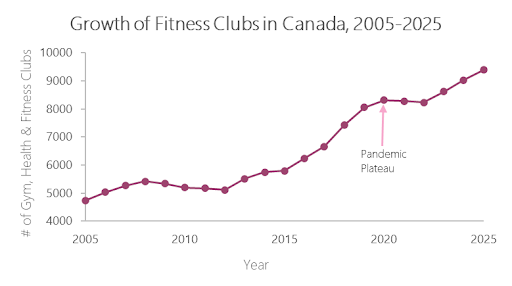
Source: IBISWorld, 2025
Beyond physical accessibility, digital forces have reshaped how people see fitness – shifting it from a quiet hobby into a hyper-connected culture of influence, information, and expectation.
Social Media Influence
You would be hard-pressed to find a Gen Z’er who is not on social media. 76% of Gen Z regular exercisers look to influencers for fitness guidance, leading to increased gym usage. But the same feeds that inspire also distort; viral aesthetics and curated physiques often create unrealistic expectations, fuelling body dysmorphia that drives some young people into the gym with the feeling of insecurity, rather than aspiration.
Digital Health Literacy
Including and beyond social media, fitness information is more accessible than ever. Gen Z has unprecedented access to data and research courtesy of the internet, making them more informed in their decisions and becoming more literate in their lifestyles and fitness decisions. This connectivity through channels such as YouTube, Reddit, and other fitness forums fuels the rapid spread of training methods, recovery science, and nutrition hacks across networks and social circles.
New Expectations
For Gen Z, gyms are no longer just workout zones but holistic community hubs, places where physical fitness, mental wellness, and social belonging come together. Consider the UK, where Gen Z has fueled a record surge in memberships by treating gyms as social outlets as much as workout zones.
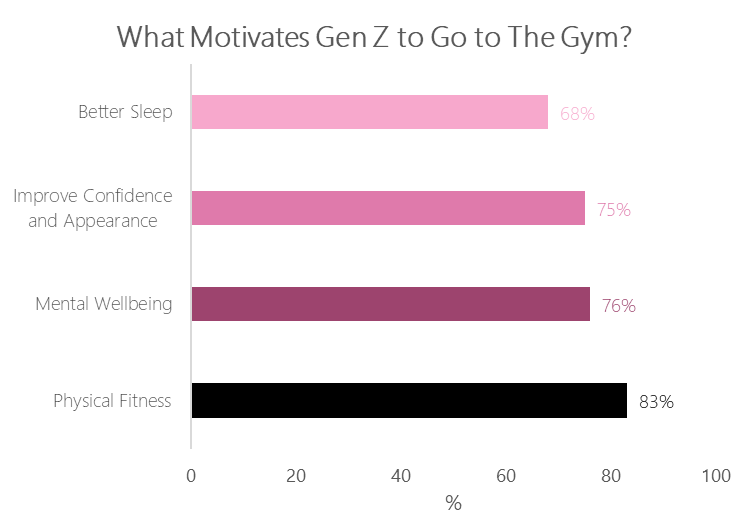
Gen Z has reasons beyond physical fitness to go to the gym.
Source: The Guardian
These motivations align closely with expectations. Gen Z gym-goers want to improve their aesthetics, appearance, and confidence, where as a result strength training has taken over cardio as the workout of choice in the gym.
And with increasing motivations of mental wellbeing and sleep, wellness extras such as saunas, recovery rooms, and meditation areas are creating a new expectation of restoration that complements training within the gym.
Repping to Failure: The Planet Fitness Case
The commercial gym was never designed to maximize attendance, but instead designed to monetize absence. Low monthly fees brought members in, but the real economics and subsequent profit relied on them staying home. Up to 67% of gym memberships go completely unused, meaning a significant chunk of members pay without ever showing up, a foundational flaw that commercial gyms have been banking on.
While other chains balance their economics with personalized training packages or specialty offerings, Planet Fitness has taken a different route. As the only publicly traded commercial gym in North America, the company deliberately targets first-time gym-goers and casual members with its famously low price point, no-frills approach, and “Judgement Free Zone” branding. What began as a $10-a-month empire (now $15) is now the backbone of a franchising machine, driven by volume and oversubscription and sustained by the expectation that most members will rarely show up. The real genius is that Planet Fitness monetizes laziness twice: not going to the gym, and treating a $15 monthly charge as too cheap to bother cancelling.
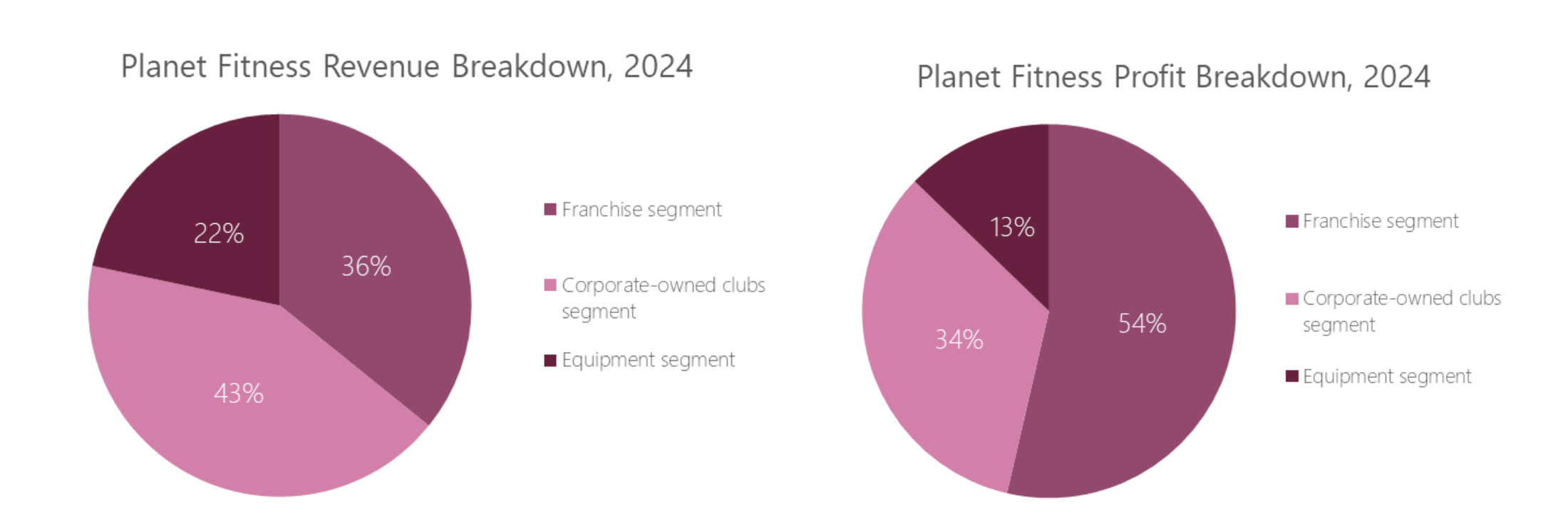
Source: Planet Fitness 2024 Annual SEC filing (Form 10-K)
While Planet Fitness reports steady cash flow from all three segments, the franchising segment is the real engine that powers the profit machine; the company skims 7% of all membership dues from franchisees in the form of royalties. When combined with equipment sales (mandated replacements for franchisees every 5-9 years), together they account for roughly two-thirds of total company profit. Both streams are contractually locked in, creating the backbone of the ~90% recurring revenue base that Planet Fitness is built on.
Of the 2,722 locations in operation at the end of 2024, 2,445 were franchised versus just 277 corporate-owned. In other words, nearly 90% of the system is run by franchisees. As a result, franchisees are left scrambling to cover rising costs when gyms are actually busy; this pressure is only further intensified as Gen Z continues to flood gyms with healthy habits that clash against a business model built on outdated assumptions of absence.
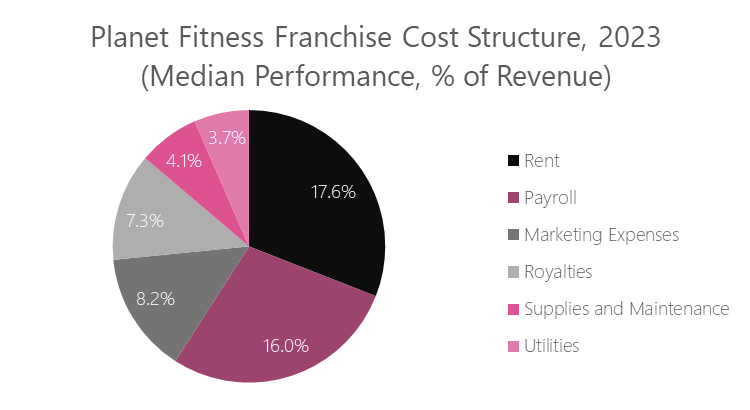
Source: Planet Fitness 2024 Annual Franchise Disclosure Document (FDD)
While marketing, rent, and royalties remain largely fixed for a Planet Fitness franchisee, Gen Z’s heavier gym usage drives up the variable costs Planet Fitness can’t control: payroll rises as more staff are needed, utility costs surge, and equipment wears out faster, pushing maintenance higher.
Faced with narrowing margins and rising operating costs, Planet Fitness was forced to raise its base membership for the first time since 1998, from $10 to $15 last May. If the trend continues and variable costs keep climbing, franchisees will be left with two bad options: cut corners through thinner staffing and worn-down equipment, or pass along the pain with higher fees that erode the baseline value proposition of a cheap and accessible gym.
Staying on the Treadmill: PureGym’s Case Study in Adaptation
PureGym is the UK’s largest commercial gym chain, built on the same low-cost model as Planet Fitness. Yet its members are far more present: with over 100 million visits across 2.3 million members in 2024, the average works out to roughly 45 visits per year per member – nearly one trip every eight days, which is unusually high for a budget gym.
Sources: PureGym 2024 Annual Report, Planet Fitness 2024 Annual Franchise Disclosure Document (FDD)
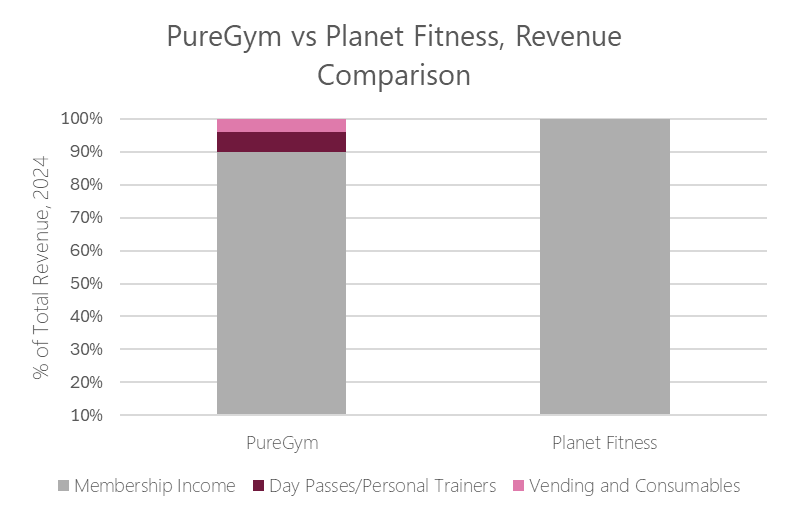
With 10% of PureGym’s revenues coming from offerings such as one-time day passes, personal trainer bookings, and in-gym consumable purchases, the chain has diversified ways to make money beyond flat membership fees. And as Gen Z’s presence in gyms continues to rise, so does the demand for day passes, personal training, and on-site vending consumables. Each additional visit directly correlates with incremental spending, allowing PureGym’s revenues and margins to rise as their facilities increase in usage.On the other hand, Planet Fitness actually lost money at the club level on ancillary offerings, including beverage sales, apparel, and branded headphones. Demand for such items is low - few members view the gym as a retail hub, which ends up leaving Planet Fitness locations with unsold stock on shelves and very low turnover on such items.
Looking a step further at membership offerings beyond the base level, the perks of the Planet Fitness membership offerings are structured quite differently than that of PureGym’s.
At first glance, both Planet Fitness’s Black Card and PureGym’s Plus tier have similar perks, such as multi-club access and discounted drinks. The Black Card offers unlimited guest privileges, free small group classes, tanning, hydromassage, and recovery lounges. While the wellness perks (hydromassage, recovery) resonate with Gen Z’s approach to holistic health, the unlimited guest feature massively increases usage without generating additional revenue.
Conversely, PureGym’s Plus membership takes a different approach. Guest privileges are capped at four visits per month, a feature that limits excess traffic while still providing social flexibility. Beyond that, the real profitable perks are tied to deeper engagement within the PureGym community. Classes are free across all tiers, but Plus members receive priority booking, which helps keep them consistently attending. PureGym also runs specialty sessions with guest instructors that carry an extra charge, creating direct upsell opportunities.
Source: PureGym 2024 Investor Report, Planet Fitness 2024 Annual SEC filing (Form 10-K). GBP to USD Conversion as of 9/1/2025
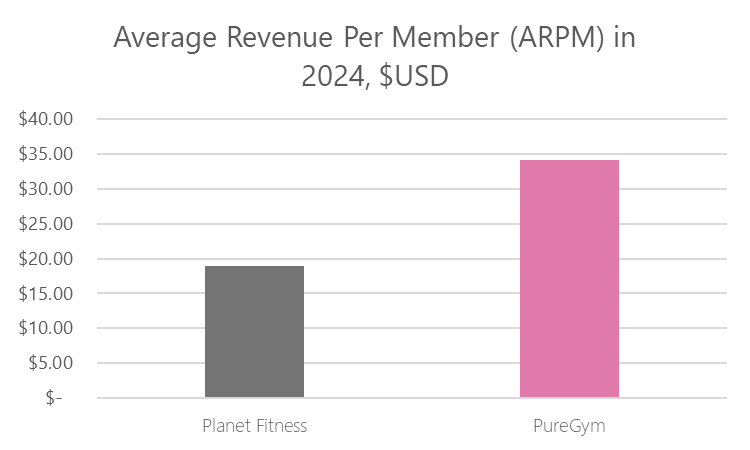
With PureGym’s competitive advantage centered around diversified ancillary revenues and premium membership offerings aligning with consumer needs, the gap in ARPM becomes quite significant. PureGym earns over $30 per member each month, whereas Planet Fitness makes less than $20 per member. This disparity also reflects each chain’s ability to upsell members into higher-priced membership, where PureGym outpaces Planet Fitness.
The Collapse of the Paradox
While Planet Fitness continues to benefit from the reliability of recurring membership dues across its corporate and franchise system, its inability to adapt its model leaves it exposed. Gen Z’s presence-driven habits are colliding with a structure built to monetize absence, pressuring business areas where perks amplify usage but fail to increase revenue along the way. By contrast, PureGym demonstrates how diversified ancillary revenues and premium offerings can turn higher attendance into higher margins.
The industry-wide shift is clear as newer generations start to gather more purchasing power: chains that can rewire their models towards diversified revenue streams, engagement-driven perks, while balancing for usage will maximize Gen Z’s customer lifetime value. For Planet Fitness and its commercial gym peers, the challenge is whether they can reimagine their layouts, trading rows of underused cardio machines for strength zones, recovery areas, and social classes while designing them so that revenues rise with actual use.
But in the end, the paradox that once powered the industry is collapsing, and only those who monetize presence will stay standing.
Sources for Visuals:
Planet Fitness 2024 10-K Filing
# of gyms in Canada, IBISWorld Report
Planet Fitness 2025 Investor Presentation