
Once Upon a Time in Hollywood: Productivity, Technology, and the Rising Cost of Cinema
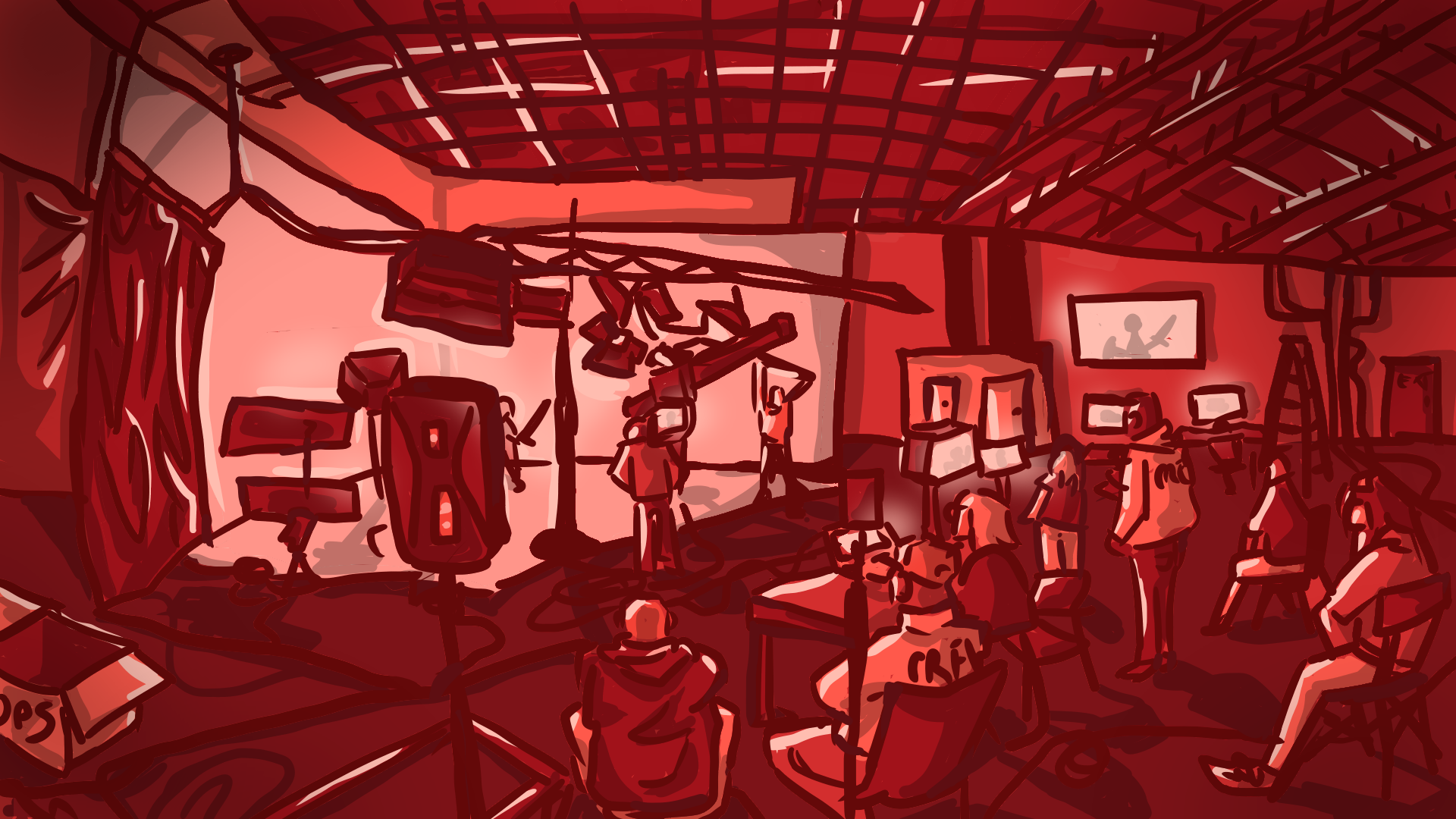
Illustrated by Evelyn Turnbull
Setting the Scene
Whether it is tentpole summer blockbusters or small-scale independent productions, movies remain one of the most widely consumed and culturally significant forms of entertainment, shaping how we interact with stories and spectacle. Today, the film industry continues to expand in scale and ambition, supported by increasingly sophisticated technology and global distribution networks. However, despite these advances, the cost of producing films has continued to rise rather than fall over the past few decades, particularly into the 21st century.
This article will explore why this contradiction persists. Digital tools, visual effects, and modern production techniques have transformed how films are made. However, they have not eliminated the fundamental reliance on large teams of skilled labour and complex coordination. As a result, many of the efficiency gains seen in other parts of the economy have not fully translated into lower production costs in filmmaking, raising questions about how value and productivity evolve in creative industries over time.
Behind the Curtain
One notable explanation for this phenomenon is Baumol’s Cost Disease, a theory developed by economists William Baumol and William Bowen in the 1960s. This theory argues that labour-intensive industries often experience rising costs even when they fail to achieve the same productivity gains occurring throughout the broader economy.
While sectors such as manufacturing have benefited from automation and technological innovation, allowing workers to produce more output in less time, other industries continue to rely on human labour that cannot be meaningfully accelerated or replaced.
Filmmaking exemplifies many of the characteristics outlined in this theory. Although digital cameras, computer-generated imagery, and editing software have transformed parts of the production process, the core of making a film remains deeply collaborative and people-driven. Actors perform scenes, directors guide creative decisions, cinematographers and production crews coordinate complex shoots, and editors shape the final product.
All of these tasks can be enhanced by technology but cannot be fundamentally stripped down without changing the nature of the work itself. By examining the film industry through Baumol’s Cost Disease, we can investigate why rising film production costs may be less a sign of inefficiency so much as a consequence of the industry’s relationship between creativity, labour, and productivity.
Relevance to Hollywood
While digital platforms can instantly stream a movie to millions of viewers at virtually zero marginal cost, the actual creation of the movie remains stubbornly dependent on labour. The core value of a film relies on “creative inputs,” or original concepts, directing, and human performance, that cannot be automated or accelerated without compromising the final product. A director cannot film twice as fast, and actors cannot deliver their dialogue at double speed to improve efficiency. Because the final output remains fixed (one completed film), actual labor productivity during production remains flat.
The economic “disease” sets in through wage competition across the broader labor market. In highly progressive sectors like technology and software engineering, rapid productivity growth naturally drives up average market wages. To retain its highly specialized technical and creative talent such as visual effects artists, sound designers, and engineers, Hollywood must match these rising market rates.
As macroeconomic data shows, when a stagnant-productivity sector is forced to pay competitive, modern wages without any corresponding increase in physical output, its relative production costs and prices must rise. Hollywood is caught in this exact bind, where it is paying 21st century wages for a process with the same physical time constraints it faced a century ago.
The Evidence in Modern Cinema
Rising Budgets
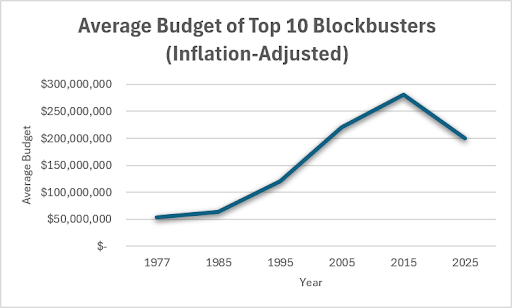
To see Baumol’s Cost Disease in action, we only need to look at the rising cost of admission to Hollywood’s roster of blockbusters. In 1977, the dawn of the modern blockbuster era, the average inflation-adjusted budget for a top-10 grossing film was a modest USD $53.8 million, (2025 dollars). By 2015, that baseline had skyrocketed by over 400 per cent to an average of USD $280.7 million.
Even with the slight reduction in reported costs seen in 2025, the average top-10 budget still hovers at a massive USD $200.5 million. This demonstrates that while technology has advanced exponentially since the 1970s, especially concerning the vast improvement in visual effects, the baseline capital required to produce a highly competitive theatrical spectacle has permanently shifted to a higher floor.
Source: Box Office Mojo
Return on Investment, Marketing, and Distribution
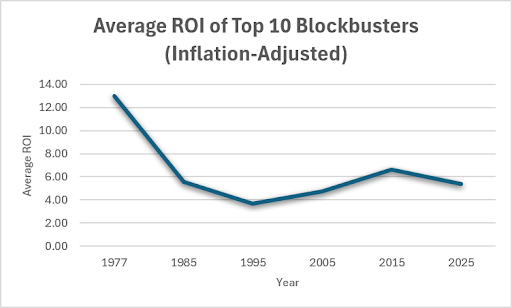
The capital efficiency of blockbuster productions has also collapsed over time. In 1977, the top-10 films yielded an astronomical average ROI multiplier of 13.01x their production budgets. By 2025, this average plummeted to just 5.35x. Large studios are now risking four times the upfront capital to achieve less than half the percentage return from five decades ago.
This structural ROI squeeze is further obscured by the fact that reported profitability is often distorted. Official, publicly available budgets represent only a fraction of the total capital required, as they routinely leave out massive global marketing and distribution costs. Because these unpublicized expenses are kept off the official records, the true costs of producing and releasing modern cinema remain buried within the bookkeeping of studio ledgers.
Source: Box Office Mojo
The Death of the Mid-Budget Film
This relentless pressure on capital efficiency has hollowed out studio portfolios, driving the near-extinction of the mid-budget film. Historically, character-driven dramas and comedies costing between USD $20 million and $80 million served as a vital financial safety net, balancing out a studio’s riskier bets. However, as production costs have inflated across the board, the economic math for these films no longer works.
Recent research highlights the forces behind this collapse, confirming that while massive blockbusters are highly volatile, they still dominate market attention. Furthermore, the rise of digital streaming has not levelled the playing field. Instead, it has funneled more wealth to the very top. Under “superstar theory,” when viewers have unlimited choices, they tend to cluster around the same few high-profile releases.
Faced with this market reality, studios can no longer justify the risk of moderate theatrical runs. The middle tier has been completely glossed over, resulting in a Hollywood binary economy of massive franchises or micro-budget productions.
Ultimately, this cinematic landscape reveals the true impact of Baumol’s Cost Disease on the American film industry: a fragile market where studios must risk more capital than ever before, yet have fewer mid-budget lifeboats to keep them afloat when massive bets fail.
Complications With New Technology
Silver Screens: Digital Tools and Production Efficiency
While economic pressures continue to constrain studio profits, the industry has turned to technology to help manage day-to-day operations. Research on the digitization of movie making shows that shifting to fully digital workflows can make the filming process much more efficient. Moving away from physical film reels to digital files eliminates expensive material costs, makes it easier to organize footage, and shortens the time spent in the editing room.
However, these new tools change where the money goes rather than saving it entirely. While digital programs make certain creative steps easier and faster for crews, they also bring new expenses. Studios now face ongoing costs to pay for high-end software licenses that can handle cloud-based sharing for global teams and digital data protection.
Artificial Intelligence vs. The Human Touch
Alongside digital pipelines, artificial intelligence is also expanding across both pre-production and post-production processes. Industry analysis emphasizes that AI tools can optimize cost-effectiveness, offering filmmakers faster methods to draft scripts, storyboard concepts, and generate complex visual effects.
However, these efficiency gains come with heavy institutional friction. The integration of automated algorithms triggers fierce ethical controversies over copyright, creative displacement, and labor rights. Consumer sentiment also remains cautious, with recent survey data showing that audiences are particularly uncomfortable with AI-generated actors and screenplays, even as they are more accepting of AI-assisted visual effects and sound design.
Furthermore, research points out a stark qualitative boundary: AI-generated outputs often suffer from a noticeable lack of human touch and emotional depth. Rather than replacing human artistry, AI acts as a highly contested assistant, improving raw speed while leaving the core creative usage heavily dependent on human professionals.
Beyond Hollywood
Beyond filmmaking, this structural math applies directly to other service-driven fields. Labour-intensive industries like healthcare and education require a fundamentally stable amount of human time to deliver quality results. Because wages in these stagnant-productivity sectors must rise at a similar pace to those in highly automated fields to retain qualified professionals, the real cost of personal services climbs relentlessly over time.
Research across advanced economies confirms that this dynamic represents a major supply-side driver of long-term expenditure growth. Even as advanced tools and digital methodologies are introduced into specialized environments like acute clinical care or higher education, the core value remains anchored to direct, person-to-person delivery.
Consequently, when overall economic productivity expands, Baumol’s Cost Disease counterintuitively exacerbates funding pressures on public and private services, rendering them structurally more expensive relative to mass-produced physical commodities.
Ultimately, filmmaking illustrates a fundamental economic truth: that technology can change how we create, but it cannot automate human creativity. Whether on a Hollywood set or in a university lecture hall, the value of human-driven services remains bound to time and collaboration.
As the industry moves forward, managing Baumol’s Cost Disease will require a careful balance. Studios must embrace digital tools to optimize their workflows without stripping away the emotional depth that audiences crave. In a binary economy of massive blockbusters and micro-budgets, success may eventually belong to those who learn to navigate these structural forces safely.